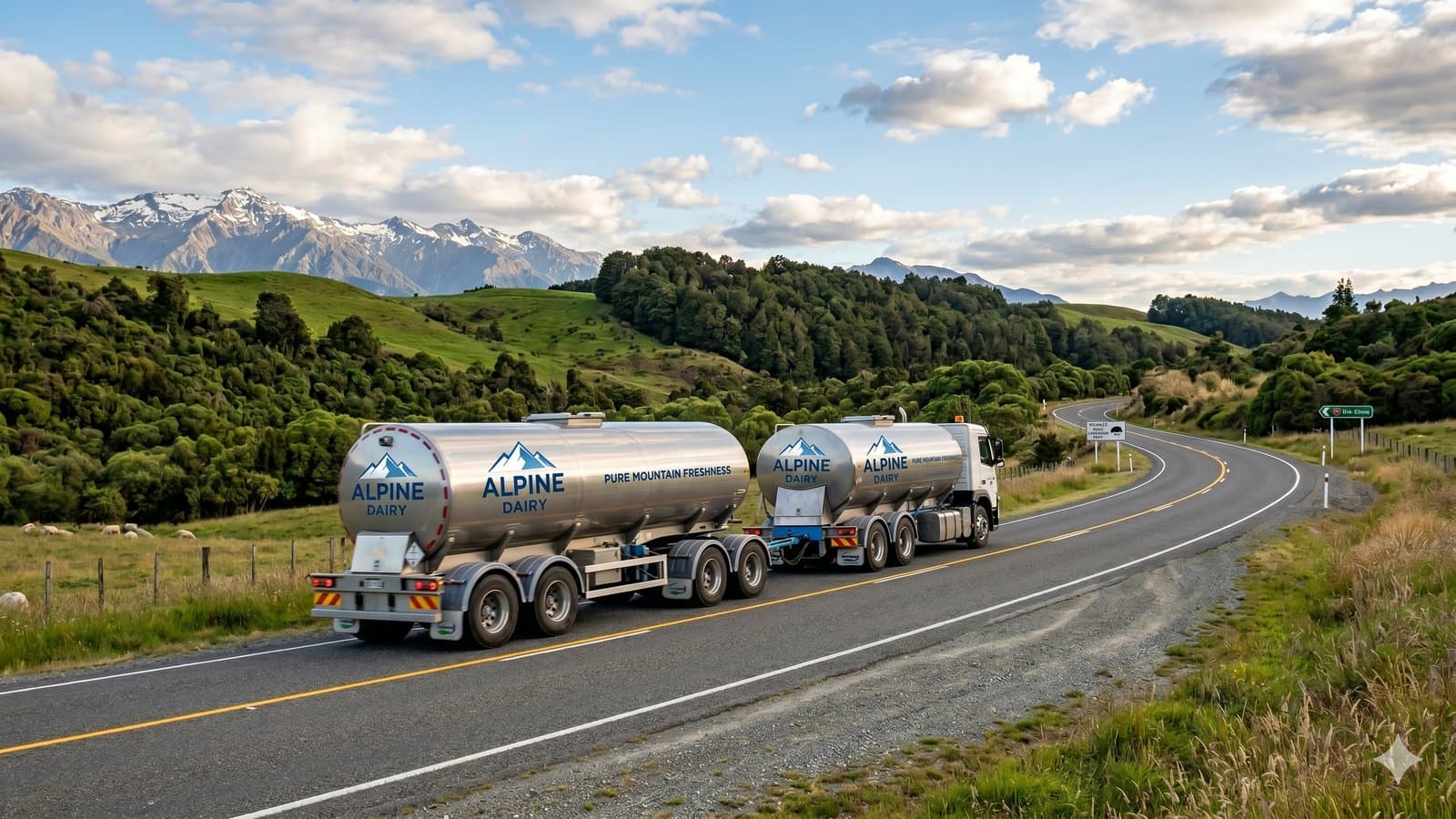
Tankers & Bulk Liquid Transport Insurance
Specialist cover for fuel tankers, milk tankers, water carriers, and chemical tankers with hazardous goods and environmental liability.
⚠️ Key Risks
- •Fuel spill and environmental contamination
- •Hazardous goods incident — fire and explosion
- •Milk load spoilage and dairy company liability
- •Rollover with liquid cargo shift
- •Third-party environmental damage claims
- •Chemical burns to responders at incidents
✓ Coverage Checklist
- ✓Comprehensive motor vehicle — agreed value
- ✓Environmental liability cover
- ✓Hazardous goods cover (if applicable)
- ✓Carriers liability
- ✓Public liability $5M+
- ✓Cleanup and remediation costs
- ✓Pollution liability extension
Tanker operators face a risk profile unlike any other category of heavy vehicle operator. When a fuel tanker rolls on the Desert Road, or a milk tanker is involved in a collision on a Southland dairy road, the consequences extend far beyond the vehicle damage itself. Environmental contamination, regulatory liability, and remediation costs can dwarf the vehicle loss — and without the right insurance structure, those costs fall directly on the operator.
The tanker sector in this country encompasses several distinct sub-sectors: petroleum products (fuel distributors supplying farms, filling stations, and industrial users nationwide), dairy collection (milk tankers are among the most visible rural heavy vehicles on Waikato, Taranaki, and Southland roads), water transport, chemical and industrial liquid carriers, and food-grade bulk liquid transport. Each sub-sector has a different risk profile, different regulatory regime, and different insurance requirements. A specialist broker will treat these differently — and you should insist they do.
Environmental Liability — The Hidden Exposure
A fuel spill of any significant volume is an environmental incident under the Resource Management Act 1990 (RMA). Regional councils — Environment Waikato, Horizons Regional Council, Environment Canterbury, and others — have enforcement powers and can issue cleanup directions with full cost recovery against the responsible party. If fuel reaches a waterway — even a small drain, a road-side channel, or a small tributary — the remediation costs can be catastrophic.
Documented soil and waterway contamination events involving fuel spills in this country have run from $200,000 to over $1,500,000 in remediation costs. The RMA requires the contaminated party to remediate to a standard set by the regional council — a standard that may require removing and disposing of contaminated soil, installing groundwater monitoring wells, and monitoring for years. These are not short-term costs.
Standard public liability policies typically exclude gradual pollution — and while a fuel spill itself is sudden, the contamination effect can be gradual as product leaches through soil to groundwater over weeks and months. This is a well-known coverage gap. A specialist pollution liability extension specifically addresses it, covering both sudden and gradual pollution events arising from tanker incidents. All tanker operators should carry this extension as a non-negotiable component of their insurance.
Ready to get specialist cover?
Connect with a specialist broker — response within 24 hours.
Hazardous Substances — HSNO and ADG Obligations
Fuel tankers operating in this country carry Class 3 flammable liquids under the Hazardous Substances and New Organisms Act 1996 (HSNO Act). The HSNO Act prescribes requirements for placarding, driver certification, emergency information panels (EIPs), vehicle equipment (fire extinguishers, spill kits), and load documentation.
If your tanker carries dangerous goods under the ADG (Australian Dangerous Goods) Code — which applies in this country as adopted under Land Transport Rule 45001 — you have additional obligations around route planning, tunnels and bridge crossings, and incident reporting. [Waka Kotahi NZTA](https://transport.govt.nz) monitors dangerous goods compliance and can impose significant penalties for breaches.
Your insurer must know you carry hazardous substances. Some policies include hazardous goods cover as standard; others exclude it without a specific endorsement. If you have not explicitly confirmed with your broker that hazardous goods incidents are covered, assume they are not.
Emergency response costs — specialist hazmat crews, environmental responders, Fire and Emergency NZ call-out costs — can run to $50,000 to $200,000 for a serious fuel spill incident. These costs must be explicitly covered in your policy, not left to chance.
The Dairy Sector — Milk Tanker Specifics
Milk tankers operate in a very different risk context from petroleum tankers. The liquid is not flammable or environmentally hazardous in the RMA sense, but the operational and contractual context creates its own specific risks.
Ready to get specialist cover?
Connect with a specialist broker — response within 24 hours.
Fonterra and the independent dairy processors (Synlait, Open Country Dairy, Westland Milk Products) operate their own or contracted milk collection fleets under strict quality assurance requirements. A milk tanker operating in the Fonterra supply chain is subject to Fonterra's carrier quality standards, which include vehicle hygiene audits, driver training requirements, and documentation of collection and delivery. Failure to meet these standards is a contract breach that can result in loss of the transport contract — a significant business risk for operators heavily reliant on dairy collection work.
The specific milk tanker insurance risk is load contamination. If diesel fuel, cleaning chemicals, or any foreign substance enters the milk compartment during collection, the entire load — potentially $15,000 to $40,000 worth of raw milk — is lost. The dairy processor will claim against the carrier under the Contract and Commercial Law Act 2017 (CCLA). Milk load contamination cover — a specialist endorsement that responds specifically to this scenario — should be a mandatory inclusion for dairy tanker operators.
Downstream processing losses — where a contaminated milk load causes issues in the factory and affects additional product beyond the original load — represent a further liability. This requires a specific contract liability extension, as standard carriers liability limits are typically set per-consignment and may not capture the full extent of processing losses.
Fuel Tanker Fire Risk
A petroleum tanker incident involving ignition is a worst-case scenario: the potential for a BLEVE (boiling liquid expanding vapour explosion) or sustained fire creates catastrophic third-party liability. While tanker fires are rare due to the safety engineering built into modern tanker design, they do occur — and when they do, the consequences for third parties near the incident are severe.
Public liability cover for fuel tanker operators should be a minimum of $5 million, with many experienced operators carrying $10 million or more. The [National Road Carriers Association](https://natroad.co.nz) recommends reviewing your public liability limit against your most hazardous route and load type annually.
Ready to get specialist cover?
Connect with a specialist broker — response within 24 hours.
Liquid Surge and Vehicle Handling
Partially filled tankers present a unique vehicle dynamics challenge. Liquid surge during braking and cornering — sometimes called free surface effect — can dramatically affect vehicle stability, particularly on tank designs without effective baffling. Modern tanker designs use baffle systems and surge mitigation design, but partially loaded runs (common in rural milk collection where tanks fill progressively along the route) still carry elevated rollover risk.
Insurers rate tanker cover with this in mind. Documented driver training specific to tanker operation — particularly the management of partially loaded tanks — and evidence of vehicle inspection for baffle integrity are underwriting factors that can influence both premium and policy terms. The Land Transport Act 1998 vehicle inspection requirements for tankers include specific provisions for tank condition and equipment; staying current with COF (Certificate of Fitness) requirements demonstrates compliance culture.
Chemical and Industrial Liquid Carriers
Chemical tankers carry a wide range of products — fertiliser liquids, industrial acids and bases, food processing chemicals, and specialist industrial products. Each product class has specific handling requirements, incompatibility risks (some chemicals must not be carried in tanks previously used for other products without specialist cleaning), and environmental hazard profiles.
The [Health and Safety at Work Act 2015](https://worksafe.govt.nz) (HSW Act) requires operators carrying hazardous chemicals to have documented emergency response plans, driver training, and spill response equipment. [WorkSafe NZ](https://worksafe.govt.nz) can inspect chemical transport operations and investigate incidents.
Chemical spill liability — particularly for acids, alkalis, or persistent organic compounds that contaminate soil — can generate remediation claims that run for years and exceed $1,000,000. A standalone environmental liability policy, rather than an endorsement to a standard motor vehicle policy, may be appropriate for operators carrying high-hazard chemical products.
Ready to get specialist cover?
Connect with a specialist broker — response within 24 hours.
Agreed Value — Essential for High-Value Tanker Assets
A modern articulated petroleum tanker with a multi-compartment stainless steel tank body represents a total asset value of $350,000 to $600,000. A specialist food-grade liquid tanker can cost more. These are not vehicles where market value depreciation schedules can be allowed to erode your sum insured below replacement cost. Agreed value policies are essential for tanker operators — the agreed value is set at policy inception, reviewed at renewal, and paid in full on a total loss without depreciation argument.
Tanker bodies are specialist items with long lead times. A replacement tank body for a petroleum tanker, manufactured to the required specifications and fitted to an existing chassis, can take six to nine months to procure. During that time you need downtime cover to maintain cash flow — a daily benefit reflecting your actual net daily revenue from tanker operations. Calculate this figure accurately and review it at every renewal.
NZTA Route Planning and Driver Certification
[Waka Kotahi NZTA](https://transport.govt.nz) has specific route provisions for vehicles carrying dangerous goods. Certain tunnels (the Lyttelton Road Tunnel, the Mt Victoria Tunnel in Wellington) have restrictions on hazardous goods vehicles. Bridge load limits may affect heavily laden tanker routing on secondary roads. The Land Transport Act 1998 requires operators to be aware of and comply with all route restrictions applicable to their vehicle and load class.
Dangerous goods driver endorsements (Class D endorsement on the driver's licence for those transporting specific hazardous substances) are required under the Land Transport Rule: Dangerous Goods 2005. If your drivers operate petroleum tankers without the appropriate endorsement, both a regulatory breach and an insurance coverage gap may exist. Verify driver endorsement currency as part of your regular compliance checks.
Fonterra and Dairy Supply Chain Obligations
Fonterra's contracted milk collection tankers operate under Fonterra's supplier transport code, which sets hygiene standards, driver conduct requirements, and documentation obligations. Non-compliance with Fonterra's supplier code is a contract breach that can result in removal from the collection roster — a major commercial risk for operators whose business depends on the Fonterra supply chain.
Ready to get specialist cover?
Connect with a specialist broker — response within 24 hours.
Fonterra's own quality assurance team audits collection vehicles and drivers. Insurance does not substitute for contract compliance, but it does protect you against the financial consequences of incidents that occur despite compliance — milk load contamination events, vehicle damage, third-party claims arising from your operation on Fonterra-designated collection routes across the Waikato, Taranaki, Canterbury, and Southland dairy regions.
Tanker Design, Age, and Underwriting
The age and specification of your tanker body significantly affects insurability and premium. Older tank bodies — particularly those manufactured before modern composite lining and leak-detection technology became standard — face higher scrutiny from underwriters. Tank body inspection certificates, lining condition reports, and valve and fitting maintenance records are all relevant to the underwriting conversation.
A tanker operating under a current tank inspection certificate from an accredited inspection body demonstrates to the insurer that the tank's structural integrity has been formally assessed. Some insurers make a current tank inspection certificate a condition of cover for petroleum and chemical tankers; others apply a premium loading for tankers without current certificates. Confirm the position with your broker before renewal and schedule your tank inspection in advance of the renewal date to avoid gaps.
The Land Transport Act 1998 has specific requirements for tanker vehicles operating on public roads, including COF inspection intervals and requirements for specialised tanker-related fittings. Staying current with all regulatory inspection and certification requirements is the baseline of a compliant, insurable tanker operation.
Tanker Driver Training and Endorsements
Tanker operations require a higher level of driver skill and awareness than general freight. The dynamic handling characteristics of liquid loads, the specific risks of hazardous goods transport, and the environmental consequences of a spill or overfill all demand that tanker drivers receive specific training beyond a standard heavy vehicle licence.
Ready to get specialist cover?
Connect with a specialist broker — response within 24 hours.
For petroleum tanker operations, Dangerous Goods driver endorsements under the Land Transport Rule: Dangerous Goods 2005 are legally required. For milk tanker operations, dairy industry hygiene training and documented competency in milk collection procedures is expected by Fonterra and other dairy processors. For chemical tanker operations, product-specific HSNO training and documented emergency response competency is both a regulatory expectation and an insurance requirement.
An unendorsed driver operating a petroleum tanker is a statutory breach — if an incident occurs, the insurer will examine driver endorsement status as part of the claims assessment. Verify endorsement currency for every driver before they operate a tanker vehicle, and maintain copies of endorsement records in the vehicle and in your personnel files.
To connect with a specialist broker for tanker insurance, complete the quote request on this page and expect a response within 24 hours.
Frequently Asked Questions
Does standard public liability cover a fuel spill?
Most standard public liability policies exclude gradual pollution and may have restrictions on sudden pollution events. Tanker operators need a specific pollution liability extension or a specialist environmental liability policy. Don't assume your standard PL policy covers fuel spill remediation.
Do I need hazardous goods cover even for diesel?
Diesel is a Class 3 flammable liquid under the HSNO Act. If you transport above certain quantities, hazardous goods requirements apply. Your insurer must know you carry diesel — some policies exclude hazardous goods without a specific endorsement.
What happens if my milk load is contaminated?
Milk load contamination cover pays the value of the lost load and may also cover reasonable notification and testing costs. Downstream processing losses to the dairy company are a separate and potentially larger liability — carriers liability or a specific contract liability extension covers this.
How does the Resource Management Act affect my insurance obligations?
Under the RMA, you can be held liable for the full remediation cost of any environmental contamination caused by your tanker operation. Regional councils have cost-recovery powers that can follow you personally, not just your company. A specialist pollution liability extension ensures insurance responds to these claims.
Get a Tankers Quote
Specialist broker response within 24 hours