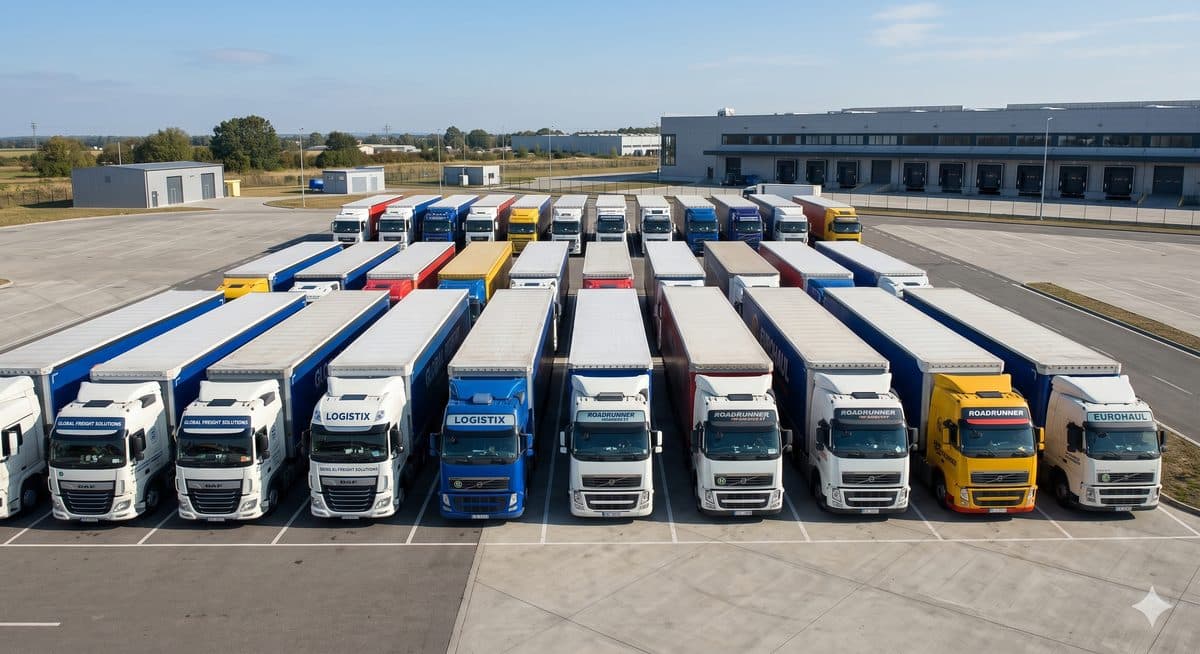
Crane Trucks & HIAB Vehicles Insurance
Specialist cover for crane trucks, HIAB loader cranes, and self-loader vehicles involved in lifting, loading, and delivery operations.
⚠️ Key Risks
- •Crane failure during lift — load drop liability
- •Overhead power line contact
- •Outrigger sinkage damaging surface or services
- •Third-party property damage from swinging loads
- •Crane overload and structural failure
- •Operator certification and competency
✓ Coverage Checklist
- ✓Comprehensive motor vehicle cover
- ✓Crane and lifting equipment cover
- ✓Statutory and employers liability
- ✓Public liability $5M+
- ✓Lifting operations liability
- ✓Breakdown cover
Crane trucks and HIAB (Hydraulic Individually Articulated Boom) vehicles are a fascinating and genuinely complex insurance risk. They combine the exposure of a heavy motor vehicle with those of a mobile lifting machine — and require both types of cover to be correctly structured to ensure there are no gaps when a claim occurs. A HIAB truck that damages a vehicle in a car park is one kind of claim; a HIAB that drops a load on a roof is another; a HIAB that makes contact with a power line is a third. Each requires a different part of your insurance programme to respond.
A modern HIAB loader crane on a 26-tonne rigid truck represents a total asset value of $250,000 to $500,000, depending on the crane specification. The HIAB unit itself — a Hiab X-HiDuo 138 or equivalent — can cost $80,000 to $180,000 new. Both the vehicle and the crane must be specifically covered, and the insurance must respond correctly whether the incident occurs during road transit, during a lifting operation, or during outrigger-deployed work on a construction site.
What Is a HIAB and What Risks Does It Create?
HIAB is a brand name that has become generic in this country for loader cranes — hydraulic knuckle-boom cranes mounted behind the truck cab and used to load and unload the truck's own cargo without requiring a separate crane or forklift. HIAB trucks are used extensively in building supply delivery, steel and structural fabrication delivery, fencing and infrastructure installation, and machinery and equipment placement.
The HIAB creates risks in several distinct modes:
Road transit mode: The crane is folded and stowed. The truck drives normally. Risks are standard heavy vehicle risks — collision, rollover, theft. The crane must be declared as part of the vehicle's insured value.
Ready to get specialist cover?
Connect with a specialist broker — response within 24 hours.
Static lifting mode: The truck is deployed on outriggers at a worksite. The crane is extended and lifts a load. This is where the most serious risks arise — load drop, structural failure, power line contact, outrigger sinkage, and radius overload. Motor vehicle insurance does not respond to these events; lifting operations liability does.
Transit lifting mode (moving crane): In some operations, the HIAB lifts a load and the truck moves with the load suspended — not a compliant practice in most circumstances, but it happens. This creates the worst of both risk modes simultaneously.
Lifting Operations Liability — The Essential Cover
Lifting operations liability is a specific insurance product that covers your legal liability for damage, injury, or loss arising from crane and HIAB operations. It is separate from — and additional to — your motor vehicle public liability section. If you are operating a HIAB truck, you need both:
- Vehicle public liability: Covers third-party damage or injury directly caused by the vehicle (collision, vehicle rollover, open door contact) - Lifting operations liability: Covers third-party damage or injury caused by the crane, the load, the rigging, or the lifting operation itself
A specialist broker will structure both covers with consistent definitions, aligned limits, and a clear understanding of which cover responds to which event. The worst outcome for a crane truck operator is to have a serious load-drop claim and find that the vehicle insurer says it is a lifting operations claim, and the lifting operations insurer says it was a vehicle incident, leaving you in the middle of a coverage dispute while a major liability claim proceeds.
Ready to get specialist cover?
Connect with a specialist broker — response within 24 hours.
Power Line Contact — Frequency and Severity
Power line contact is the most feared incident for HIAB operators working in urban environments. The combination of residential and commercial buildings with overhead power supply — common in suburban Auckland, Wellington, Christchurch, and all provincial centres — means that HIAB operators are frequently working within crane reach distance of energised power lines.
A crane boom touching a 230-volt residential line can cause electrocution, equipment damage, and a local supply interruption. Contact with a 33,000-volt distribution line — which runs along many suburban main roads — can be catastrophic: electrocution risk is severe, and the restoration of a high-voltage line requires specialist network operator work that can cost $80,000 to $200,000.
[Waka Kotahi NZTA](https://transport.govt.nz) and [WorkSafe NZ](https://worksafe.govt.nz) have both issued guidance on safe working distances around power lines for mobile plant operators. The Health and Safety at Work Act 2015 (HSW Act) requires operators to identify and manage the power line risk before commencing a lift. An incident involving power line contact where no pre-lift assessment was documented will face scrutiny from both WorkSafe and your insurer.
Lines companies — Transpower, Vector, Wellington Electricity, PowerNet — have full cost recovery rights for restoration work caused by third-party contact with their lines. Your public liability policy must specifically cover power line contact events, including downstream restoration costs and consequential loss claims from affected electricity consumers.
Outrigger Damage — Subsurface Services and Structural Damage
When a HIAB truck is deployed on outriggers, each outrigger pad bears a significant point load — potentially $50,000 to $100,000 per pad, depending on the crane capacity and the load being lifted. This load is concentrated in a small area and can:
Ready to get specialist cover?
Connect with a specialist broker — response within 24 hours.
- Crack or deform sealed road surfaces - Damage kerb edges and footpath surfaces - Sink into soft ground, causing the crane to become unstable - Rupture underground services (water mains, gas pipes, fibre optic cables, power cables) that were not located before deployment
Service location before outrigger deployment is an obligation under the [Health and Safety at Work Act 2015](https://worksafe.govt.nz) — Dial Before You Dig (0800 248 344) is the service location coordination service, and use of it before any ground-penetrating work or heavy deployment is strongly recommended. An outrigger through an unlocated water main can flood a street and generate a $30,000 to $80,000 water loss and reinstatement claim against you.
Operator Certification Under the HSW Act
[WorkSafe NZ](https://worksafe.govt.nz) regulates crane operator competency under the Health and Safety at Work Act 2015. For higher-capacity cranes — typically those rated above 10,000 kg capacity — operators are required to hold an appropriate crane-specific training and certification record. Industry certification through the Crane Association of New Zealand (CANZ) or equivalent competency assessment is the standard pathway.
An uncertified operator using a crane in a situation where certification is required is a direct breach of the HSW Act. If an incident occurs while an uncertified operator is at the controls, the insurer may decline or reduce the claim on the basis of the statutory breach — and WorkSafe may prosecute both the operator and the employer. Verify that all operators hold current certifications appropriate to the crane class they are operating, and keep copies of certification records on file.
Congested Auckland Worksites
Auckland's building boom has created congested urban worksite conditions that create specific risks for HIAB operators. Narrow sites in terrace housing developments, cranes operating adjacent to occupied buildings, restricted delivery windows that put time pressure on lifting operations, and the concentration of overhead power infrastructure in established suburbs — these factors combine to create a higher incident frequency for Auckland-based HIAB operations than for regional work.
Ready to get specialist cover?
Connect with a specialist broker — response within 24 hours.
Insurers are aware of Auckland's construction density and may apply a location loading for HIAB trucks based primarily in the Auckland metro area. Demonstrating a strong safety culture — documented lift plans for each worksite, pre-lift power line and underground service checks, operator competency records, and evidence of regular crane inspection — is the most effective way to manage this loading and present a quality risk to underwriters.
Crane Inspection, Load Charts, and Radius Management
Every HIAB and loader crane has a published load chart specifying the maximum load capacity at each extension radius and boom angle. Operating outside the load chart — attempting to lift a heavier load than the crane is rated for at a given radius — risks catastrophic structural failure: boom collapse, crane overturn, or outrigger failure. These are not recoverable situations.
Operating within load chart limits is not just a manufacturer recommendation — it is a safety obligation under the HSW Act and, more directly, a condition of your insurance coverage. A structural failure resulting from an operator exceeding the load chart is likely to be treated by the insurer as a deliberate or reckless breach, with coverage consequences. Ensure all operators understand and apply the load chart for the specific crane they are operating, and that load charts are accessible on the vehicle at all times.
Regular crane inspection — annual engineering inspection by a qualified crane inspector, plus routine pre-shift checks by the operator — is the other side of the operational safety obligation. Inspection records maintained in a log, accessible to your broker and to WorkSafe if required, demonstrate the systematic approach to crane safety that underwriters value and that regulatory compliance demands.
Agreed Value for the Crane Component
HIAB and loader cranes are specialist equipment with significant replacement cost that depreciates differently from the truck chassis. A five-year-old HIAB on a modern truck chassis may have the crane valued well below its actual replacement cost on the depreciation schedule, because crane values in the secondhand market do not follow straight-line depreciation — condition and service history matter more than age alone.
Ready to get specialist cover?
Connect with a specialist broker — response within 24 hours.
Review the agreed value for the crane component independently of the vehicle chassis at every renewal. Your broker should have access to current replacement cost data for the specific HIAB model and specification you operate. An agreed value set on the crane at $45,000 when the replacement cost is $90,000 leaves a $45,000 gap that falls directly on you at claim time.
HIAB on Multiple Bodies — Declaration Requirements
Some operators run HIAB cranes on multiple truck bodies, swapping the crane between chassis for different jobs. Others operate a fixed HIAB on a single truck but use the truck as a general delivery vehicle on days when lifting is not required. Both arrangements need to be disclosed to the insurer:
A HIAB that moves between chassis must be covered as a floating asset — declared to the insurer, with each chassis it is used on noted, and with the lifting operations liability running with the HIAB wherever it is deployed. A HIAB that is only sometimes used for lifting (as opposed to being a permanent crane truck) still creates lifting operations liability every time it is deployed in lifting mode, regardless of the vehicle's primary use classification. Never assume that a general freight policy automatically covers lifting operations liability — it does not.
Main Contractor Requirements and Site Insurance
Many crane and HIAB truck operators work as subcontractors to main contractors on construction projects. Main contractors typically require subcontractors to carry minimum insurance levels as a condition of site access — public liability at $5M or $10M, lifting operations liability at specified limits, and evidence of currency via a certificate of insurance.
Review your principal contracts and site access agreements for specific insurance requirements before committing to a project. If a main contractor requires $10M lifting operations liability and your policy has a $5M limit, you are in breach of contract from day one. Your broker should review all significant subcontract agreements and confirm your policy meets every requirement. Some specialist HGV programmes include contract review as part of their broker service — ask whether this is available from your broker.
Ready to get specialist cover?
Connect with a specialist broker — response within 24 hours.
To connect with a specialist broker for crane and HIAB truck insurance, complete the quote request on this page and expect a response within 24 hours.
Frequently Asked Questions
Is my HIAB crane covered under my vehicle insurance?
The HIAB is covered for physical loss or damage as part of the vehicle under a comprehensive motor vehicle policy — but it must be specifically declared and valued. If the crane fails during a lifting operation and drops a load, that is a lifting operations liability event — a separate cover that must be specifically arranged.
Do I need separate plant and machinery insurance for the crane?
It depends on your situation. If your truck operates on worksites primarily as a piece of plant rather than as a transport vehicle, the main contractor may require plant and machinery cover in addition to vehicle cover. A specialist broker can advise on your obligations.
What WorkSafe obligations apply to HIAB operations?
Under the Health and Safety at Work Act 2015, you must identify and manage hazards before every lifting operation — including power line proximity, ground conditions, load weights, and operator competency. Documented lift plans and pre-lift assessments are best practice and protect your insurance coverage if an incident occurs.
What public liability limit should a HIAB operator carry?
Given the potential for load-drop damage on buildings, power line contact restoration costs, and the infrastructure liability from outrigger incidents, a minimum of $5M public liability is recommended. Operators working in congested urban environments or lifting high-value loads should consider $10M.
Get a Crane & HIAB Trucks Quote
Specialist broker response within 24 hours
Related Coverage Types
Specialist Brokers
Access the brokers who specialise in crane & hiab trucks insurance.
Compare Brokers