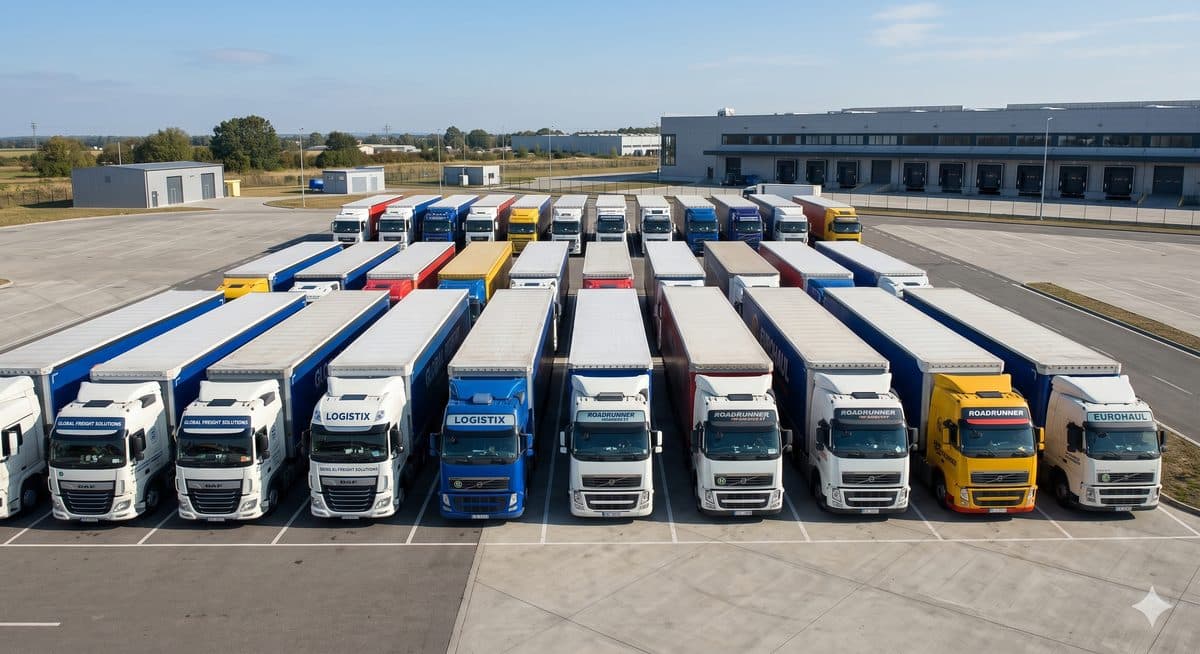
Fleet Insurance Insurance
Fleet cover for operators running 3 or more HGVs, with burning cost rating, fleet risk management, and single policy simplicity.
⚠️ Key Risks
- •Portfolio of vehicles creates high aggregate exposure
- •Driver consistency and training across the fleet
- •Fleet management and telematics compliance
- •Contract liability for principal customers
- •Fleet-wide claims history affecting renewal
✓ Coverage Checklist
- ✓Comprehensive motor vehicle — fleet basis
- ✓Carriers liability — blanket
- ✓Public liability
- ✓Fleet risk management support
- ✓Downtime cover
- ✓Employers and statutory liability
Running a fleet of heavy vehicles is a significant business operation with a correspondingly significant insurance requirement. When you move from one or two trucks to a fleet of three, five, ten, or more, the insurance approach needs to change fundamentally. Fleet insurance combines all your vehicles under a single policy, simplifies administration, and — critically — gives you access to fleet risk management tools and burning cost pricing that can deliver materially better long-term insurance economics than a collection of individual vehicle policies.
The definition of a fleet varies slightly between insurers, but as a working rule: three or more heavy vehicles under common ownership or operational control qualifies for fleet treatment in the HGV insurance market. At this scale, the administrative simplicity of a single policy, single renewal date, and single point of contact for claims already has significant value — even before you consider the premium dynamics of fleet rating.
How Fleet Rating Works — Burning Cost Explained
Fleet insurance for heavy vehicles is typically rated on a burning cost basis. This means the premium is calculated from your actual historical claims experience rather than from a market tariff rate per vehicle. The burning cost formula takes your claims paid over a rating period (typically three to five years), adjusts for claim development (some claims take years to fully settle), adds a loading for expenses and profit, and arrives at a premium that reflects your real risk.
If your fleet has a strong safety record and low claims history, burning cost rating rewards you with lower premiums than the market tariff would produce. Conversely, if your claims frequency is high — whether through driver incidents, loading accidents, or cargo claims — the burning cost reflects that reality at renewal. This creates a direct and meaningful financial incentive to invest in fleet safety.
A single bad year — a major rollover, a serious cargo claim, a significant public liability incident — can affect your burning cost for three to five years. Conversely, a sustained period of low claims experience progressively improves your burning cost position. Fleet operators who understand this dynamic and invest accordingly in risk management consistently outperform their peers in insurance economics.
Ready to get specialist cover?
Connect with a specialist broker — response within 24 hours.
Fleet Risk Management Assessments
Some insurers — particularly through brokers like Rothbury and Gallagher NZ — offer Fleet Risk Management Assessments as a value-add with their fleet programmes. These assessments review:
- Driver selection, background checking, and onboarding processes - Driver training programmes (defensive driving, load security, fatigue management) - Vehicle maintenance schedules, COF compliance, and pre-trip inspection processes - Route planning, journey management, and fatigue management systems - Load restraint practices and documentation - Incident investigation processes and near-miss reporting
The assessment identifies risk improvement actions — and completing those actions is typically recognised in your renewal premium. It also provides a documented baseline that demonstrates to underwriters that you are a quality operator who takes risk management seriously.
[Transporting NZ](https://transportingnz.org.nz) has developed fleet safety frameworks and resources that align with the Health and Safety at Work Act 2015 (HSW Act) obligations. If you are not already using the Transporting NZ safety resources, a fleet assessment is an excellent prompt to engage with them.
Telematics and Premium Impact
Telematics — GPS tracking combined with vehicle data recorders that capture speed, harsh braking events, cornering, acceleration, and driver behaviour patterns — has become an increasingly powerful tool for fleet risk management and insurance rating.
Ready to get specialist cover?
Connect with a specialist broker — response within 24 hours.
Insurers in the HGV fleet market are increasingly willing to consider telematics data as part of their underwriting. Fleets that can demonstrate through telematics data that their drivers consistently operate within speed limits, avoid harsh braking events (which correlate with fatigue and distraction), and adhere to route plans are demonstrably lower risk than those without data. Some fleet programmes offer explicit premium discounts for telematics-equipped fleets.
Beyond the insurance premium benefit, telematics data is operationally valuable: it enables driver coaching conversations grounded in real behaviour data rather than impressions, helps identify driver fatigue patterns, and provides evidence of driver performance in the event of a disputed accident liability claim.
Mid-Term Vehicle Additions and Amendments
Fleet policies handle mid-term vehicle additions and deletions more efficiently than collections of individual policies. When you add a new truck to a fleet policy, you typically notify the insurer and the vehicle is covered from that date at the fleet rate. Compare this to arranging a new individual policy for each vehicle added — a process that involves new applications, underwriting reviews, and fresh documentation for every transaction.
Similarly, when a vehicle is sold or disposed of, removal from a fleet policy is straightforward. Your broker manages the fleet schedule — a living document that tracks every vehicle, its agreed value, and its coverage — and keeps it current as the fleet changes.
Mid-term adjustments to a fleet policy require prompt notification to the insurer or broker. Adding a new truck to your operation and assuming it is covered under the fleet without notifying the insurer is a common and dangerous mistake. The fleet policy covers vehicles listed in the schedule; a vehicle not listed may not be covered.
Ready to get specialist cover?
Connect with a specialist broker — response within 24 hours.
Carriers Liability on a Fleet Basis
When you operate a fleet of vehicles carrying third-party freight, your carriers liability cover must be structured to cover the full fleet operation — not just individual vehicles. A blanket carriers liability policy covers all vehicles in the fleet, across all the freight types you carry, up to the per-consignment limit.
For a large fleet carrying diverse freight types — some vehicles carrying low-value general freight, others carrying high-value electronics or time-sensitive cargo — your broker needs to understand the full range of freight values and types to size the carriers liability limit appropriately. A blanket limit that is adequate for your average consignment but inadequate for your highest-value run leaves a gap.
Driver Training and Premium Management
Driver training is the single highest-return investment a fleet operator can make in terms of insurance economics. A trained driver has fewer at-fault incidents. Fewer incidents mean lower claims frequency. Lower claims frequency improves your burning cost. Improved burning cost reduces your fleet premium at renewal.
The [National Road Carriers Association](https://natroad.co.nz) runs driver training programmes specifically oriented to fleet operations, including the AchieveNZ heavy vehicle driver training programme. [Transporting NZ](https://transportingnz.org.nz) offers safety management tools and training resources. Investment in these programmes is documentable evidence of safety culture — which matters to underwriters as well as to the drivers themselves.
Some fleet insurers offer direct premium credits for documented driver training investment — a further financial incentive beyond the claims reduction benefit. Ask your broker whether your fleet programme includes training incentives at renewal.
Ready to get specialist cover?
Connect with a specialist broker — response within 24 hours.
Employers Liability and Statutory Liability
A fleet operation employing drivers and support staff has employer obligations under the Health and Safety at Work Act 2015. If a driver suffers a workplace injury and makes a claim against the employer for damages beyond what ACC covers, employers liability cover responds. If a regulatory breach leads to a prosecution under the HSW Act, statutory liability cover pays defence costs and any resulting fines or penalties.
Both covers are typically available as extensions to a fleet motor vehicle policy, and both are relevant to any employer operating heavy vehicles. [WorkSafe NZ](https://worksafe.govt.nz) investigates serious workplace incidents involving heavy vehicles — a fleet operator who employs drivers needs both employers liability and statutory liability as standard components of their insurance programme.
Contract Requirements and Fleet Carriers Liability
Large freight contracts — with Mainfreight, Toll, EBOS, Progressive Enterprises, Woolworths NZ, Fonterra, or other major principals — typically specify minimum insurance requirements as a condition of the transport contract. Fleet operators servicing multiple major principals may find that different principals specify different minimum limits, creating a need to maintain carriers liability limits that meet the most demanding contract requirement across the entire fleet.
A blanket fleet carriers liability policy — covering all vehicles in the fleet across all the freight types you carry, up to a single per-consignment limit — is typically the most efficient structure. Your broker must understand the most valuable freight types any vehicle in your fleet carries and the minimum limits specified in your major contracts. A fleet-wide carriers liability limit of $500,000 per consignment is adequate for general merchandise; it is wholly inadequate if some vehicles carry high-value electronics or pharmaceutical product worth $2,000,000 per load.
Agreed Values Across a Mixed Fleet
Managing agreed values across a fleet of different vehicle types, ages, and specifications is one of the most important ongoing tasks for a fleet insurance programme. A fleet that has been insured for five years without a full agreed value review may have individual vehicles significantly underinsured relative to current replacement costs — particularly in the current environment of elevated secondhand truck prices.
Ready to get specialist cover?
Connect with a specialist broker — response within 24 hours.
Your broker should provide a full agreed value review at every annual renewal, with reference to current market values for each vehicle type in your fleet. For high-value units — late-model Scania or Kenworth prime movers, specialist reefer combinations, logging trucks — the agreed value must reflect actual replacement cost rather than book value or depreciated cost. A fleet policy that performs well on paper but settles major losses at depreciated values has failed its most basic purpose.
NRC Fleet Membership and Industry Resources
The [National Road Carriers Association](https://natroad.co.nz) maintains preferred insurance programme arrangements for fleet members, along with fleet safety resources, driver training tools, and industry advocacy. Fleet operators who are NRC members consistently access better insurance terms than non-members, because the NRC's programme design and risk data allows underwriters to distinguish quality fleet operators from the broader market.
[Transporting NZ](https://transportingnz.org.nz) similarly provides fleet safety frameworks, training resources, and industry representation. Engaging with industry bodies at the fleet level — rather than as individual operator members — brings scale benefits in both programme design and industry influence on regulatory and operational matters that affect your cost base.
Fleet Claims Management — The Broker's Role
When a claim occurs across a fleet, the broker's role extends well beyond lodging the claim with the insurer. A specialist fleet broker actively manages the claims process: coordinating loss adjusters, advocating for the operator's interpretation of the event, managing reinstatement timelines, and where appropriate disputing insurer positions that are not supported by the policy wording.
For fleet operators, the relationship with the claims team at the broker is as important as the policy terms themselves. A fleet that generates a claims event every two to three months — minor at-fault incidents, cargo claims, third-party property damage — needs a broker who manages those claims proactively rather than processing them passively. Poorly managed claims that take too long to settle, where the operator's position is not actively defended, result in inflated burning costs and deteriorating premiums at renewal.
Ready to get specialist cover?
Connect with a specialist broker — response within 24 hours.
Ask your broker specifically about their claims management process: who manages claims for your fleet, how quickly claims are acknowledged and assessed, and what their track record is in disputed claims. This is a legitimate due diligence question, and a specialist fleet broker will welcome the conversation.
To connect with a specialist broker for fleet insurance, complete the quote request on this page and expect a response within 24 hours.
Frequently Asked Questions
At what fleet size does fleet insurance make sense?
Fleet policies typically become available and cost-effective at 3+ vehicles. For a fleet of 10+ vehicles, fleet insurance is almost always preferable to individual policies — both in terms of premium efficiency and claims management simplicity.
How does burning cost rating affect my renewal?
Burning cost is calculated from your actual claims paid over a rating period of typically 3–5 years. High claims years push the cost up; good years bring it down. Your broker should help you understand your burning cost calculation and what actions (claims management, risk improvement, driver training) can influence it favourably.
Do I need to notify my insurer when I add a new truck to the fleet?
Yes — immediately. A vehicle not listed in the fleet schedule may not be covered. Most fleet policies require prompt notification of any vehicle addition, and the insurer will update the schedule and adjust the premium accordingly.
Can I include light vehicles (utes, vans) in the same fleet policy as my HGVs?
Some fleet programmes allow mixed-class fleets under a single policy. Others separate HGV cover from light commercial vehicle cover. Your broker will advise on the most efficient structure for your specific fleet mix.
Get a Fleet Quote
Specialist broker response within 24 hours