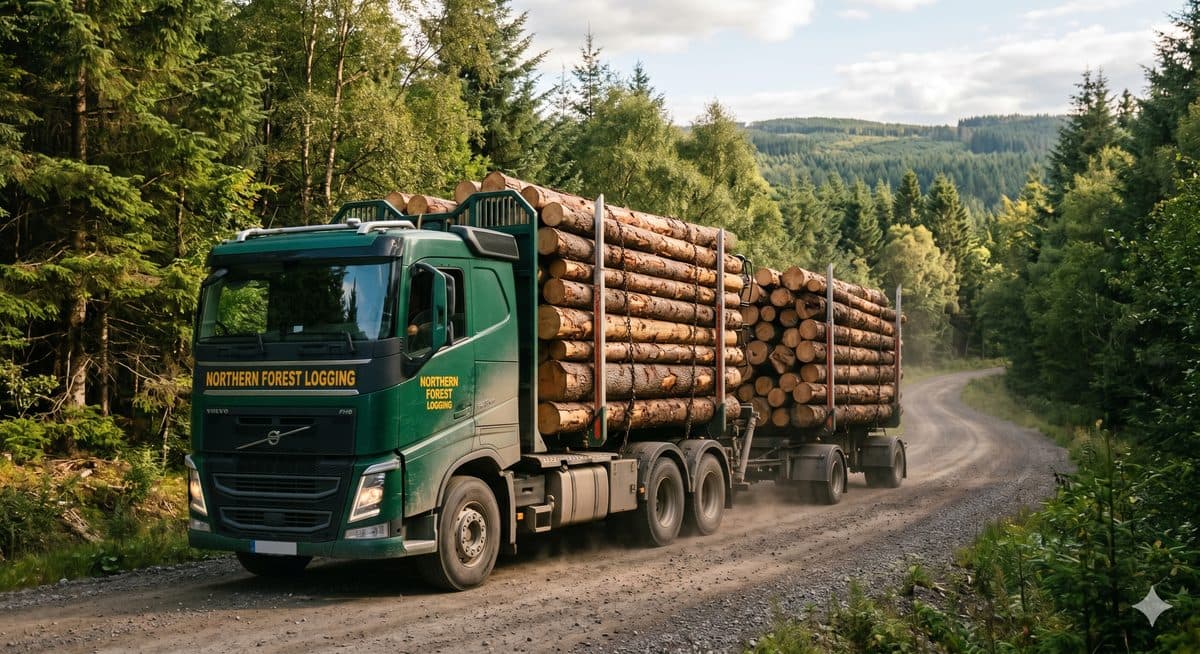
Logging Trucks & Timber Carriers Insurance
Specialist cover for logging trucks, timber jinkers, and forestry vehicles operating on bush roads and public highways.
⚠️ Key Risks
- •Bush road rollover and vehicle loss
- •Log spillage on public roads — catastrophic liability
- •Road reinstatement after heavy vehicle damage
- •Load security failures and third-party injury
- •Dust and debris damage to engine and drivetrain
- •Remote recovery costs after off-road incidents
✓ Coverage Checklist
- ✓Comprehensive motor vehicle — agreed value
- ✓Carriers liability
- ✓Public liability $5M+
- ✓Road clearing and reinstatement
- ✓Recovery costs — off-road
- ✓Personal accident for driver
- ✓Tyre and rim damage
- ✓Loading equipment and bunks
Logging truck insurance is one of the most specialist lines in the HGV insurance market — and one where the gap between an adequate policy and an inadequate one can be genuinely catastrophic. The combination of extreme vehicle values, remote and hazardous operations, high-risk roads, and potentially lethal third-party liability makes this a risk that generalist insurers routinely decline, and specialist brokers have spent decades learning to underwrite correctly.
The forestry industry is fundamental to the Gisborne, East Coast, Northland, Nelson-Marlborough, and West Coast regional economies. Gisborne alone is one of the largest forestry export regions in the southern hemisphere, with log trucks running daily from the Poverty Bay hill country to the Port of Gisborne on some of the most demanding rural road networks in the country. Hundreds of logging trucks operate across these regions every working day, running from forest gate to port, mill, or log yard. Understanding the full insurance picture — vehicle, cargo, road reinstatement, off-road recovery, and third-party liability — is the starting point for every serious conversation with a specialist broker.
The Roads — Why Logging Insurance Is Rated Higher
The roads are the primary factor that separates logging truck insurance from every other heavy vehicle category. Unsealed forestry roads — operated by Forestry New Zealand, Matariki Forests, PF Olsen, Hancock Forest Management, and private owners — are rough, narrow, steep, and carved into hillsides with no barriers on the downhill edge. The Waioeka Gorge road between Opotiki and Gisborne, the Motu road through the East Coast ranges, the forestry roads above Tolaga Bay and Ruatoria, and the Maruia Valley roads in Nelson are not routes for the inexperienced, the under-equipped, or the marginally insured.
A rollover on a forest road puts a $300,000 truck down a bank in seconds. Recovery from a remote hillside requires specialist crane hire, dedicated recovery equipment, and sometimes temporary road construction just to reach the scene. Total recovery cost from a remote bush road incident regularly exceeds $80,000 and can reach $180,000 before the vehicle is back on its wheels. That recovery cost is frequently the single largest element of a logging truck claim — and it must be explicitly covered in your policy at full value, not subject to a $20,000 sub-limit built for suburban tow trucks.
[Waka Kotahi NZTA](https://transport.govt.nz) licensing under the Land Transport Act 1998 applies on public roads. A significant portion of daily logging operation happens on private forestry roads where the forest owner sets the access conditions, the speed limits, and the maintenance obligations. Your insurance must explicitly cover both environments — on-road and off-road — with off-road recovery costs addressed by name in the policy.
Ready to get specialist cover?
Connect with a specialist broker — response within 24 hours.
Log Loads, Jinkers, and the Liability of a Spill
A single logging truck carries 25 to 30 tonnes of radiata pine, Douglas fir, or eucalyptus logs on a jinker (pole trailer) or purpose-built logging trailer using bunks, stakes, and wire rope restraints. If those logs are not properly secured and they come off on a public road at highway speed, the consequences are fatal for anyone in their path.
Log spillage incidents have killed people on public roads in this country. This is not a theoretical risk — it is a documented, recurring reality of the sector. The civil liability exposure from a fatal log spill can total $3,000,000 to $8,000,000 when personal injury claims, freight loss, road reinstatement, and emergency response costs are combined. The criminal liability exposure — WorkSafe investigation and prosecution under the Health and Safety at Work Act 2015 — is a further dimension that standard motor vehicle cover does not address, and which only experienced specialist brokers are equipped to help you manage.
[WorkSafe NZ](https://worksafe.govt.nz) classifies logging as a high-risk sector and actively investigates serious logging transport incidents. WorkSafe expects operators to demonstrate robust load security practices, regular wire rope and bunk inspection records, driver training in load restraint, and documented route risk assessments. Operators who cannot demonstrate these practices face elevated regulatory scrutiny alongside higher insurance premiums.
Public liability for logging must be a minimum of $5 million. The [National Road Carriers Association](https://natroad.co.nz) and [NZ Heavy Haulage Association](https://nzhha.co.nz) both recommend $10 million as standard on public road routes. Given the catastrophic potential of a log spill at highway speed, $5 million is a floor, not a comfortable position. Your broker should benchmark your limit against your route density, traffic volumes, and a worst-case scenario on your specific roads.
The CCLA and Your Cargo Liability
Under the Contract and Commercial Law Act 2017 (CCLA), logging carriers operating under a haulage arrangement have a legal duty of care for logs in their custody. If a load is lost in a rollover, a log slide at the harvest site, or a load collapse during transit, the forest owner or log buyer may pursue the carrier for the full value of the lost timber. Carriers liability cover responds up to the policy limit.
Ready to get specialist cover?
Connect with a specialist broker — response within 24 hours.
Export log prices are substantial: pruned export logs from the East Coast typically trade at NZD $130 to $180 per JAS cubic metre, and a full load can be worth $80,000 to $130,000. Even domestic pulp logs represent significant consignment values. A carriers liability limit of $250,000 per consignment is often inadequate for East Coast or Northland export operations. Your broker must understand the log values specific to your markets and routes, and size the limit accordingly. Under-sizing this limit leaves you personally exposed to the balance of any claim.
Road Reinstatement and Council Invoices
Forestry roads and the public roads in logging regions deteriorate rapidly under sustained heavy loading, particularly in wet winter conditions when gravel roads turn to mud and sealed roads develop pothole failures. Forestry New Zealand, private forest owners, and local councils — Gisborne District Council, Opotiki District Council, Buller District Council, Tasman District Council — all have the right to invoice carriers for reinstatement when damage reaches a threshold.
Some haulage contracts include a per-tonne road contribution, making reinstatement a predictable cost built into the rate. Others leave the carrier exposed to ad hoc invoices that arrive without warning after a wet season. Road reinstatement cover within your policy protects against invoices that fall outside your contractual provisions. Discuss your specific road contract arrangements with your broker so the cover is appropriately sized — a general reinstatement cover of $50,000 may be inadequate for an operator running a full season on a Northland forestry road.
Specialist Underwriters — Market Access Is Critical
Not all insurers will write logging truck cover at any price. Those that do — NZI through specialist broker channels, Vero, QBE, Lloyd's of London syndicates, Delta Insurance, and DUAL NZ — access the market through brokers with demonstrated forestry sector experience. Generic commercial motor insurers almost universally decline this risk or impose inadequate limits and excessive exclusions.
The underwriting process is thorough. Expect detailed questions on years of logging experience, sealed versus unsealed road split, timber species and load types, load securing equipment and certification, annual mileage on forest and public roads, driver training records, COF compliance history, and five-year claims history. Be complete and accurate in your disclosure — a claim declined for non-disclosure is catastrophically worse than a higher premium for a properly rated risk.
Ready to get specialist cover?
Connect with a specialist broker — response within 24 hours.
NZHHA and NRC — Membership That Pays for Itself
The [NZ Heavy Haulage Association](https://nzhha.co.nz) represents specialist operators including logging carriers. NZHHA membership provides access to Rothbury's preferred programme, purpose-built for this risk class, with extensions and pricing the open market cannot match. The [National Road Carriers Association](https://natroad.co.nz) has similar preferred insurer arrangements for logging sector members, including access to driver training programmes specifically developed for forestry environments.
For most active logging operators, membership of one of these bodies pays for itself through the insurance programme access alone — before counting the advocacy, industry intelligence, and training resource benefits. Ask your broker which programme fits your specific operation: routes, vehicle types, annual turnover, and claims history all influence which delivers the better outcome at renewal.
Driver Experience, Training, and Equipment Declaration
Insurers weight driver experience heavily for logging. A driver with fewer than three years of logging-specific experience is a materially different underwriting risk from a ten-year veteran on the same roads, reflected in premium rating, driver excess clauses, and sometimes a decline to insure. Investing in formal load security certification under NZQA standards, defensive driving for forestry environments, and fatigue management training both reduces actual risk and demonstrates to underwriters that you operate professionally.
Loading equipment — bunks, bolsters, stakes, and wire rope sets — must be specifically declared and valued in your policy. Wire rope alone on a full jinker configuration represents $4,000 to $8,000 in value; bunks and bolsters add more. Some operators also hold plant and machinery cover for loading equipment at the harvest site under a separate policy. Discuss this alongside your vehicle cover at every renewal to ensure no gaps exist between policies.
COF and Compliance for Logging Vehicles
Logging trucks operate under demanding conditions that accelerate wear on braking systems, suspension, tyres, and the trailer coupling and bunk systems. The COF (Certificate of Fitness) inspection regime for heavy vehicles is administered by [Waka Kotahi NZTA](https://transport.govt.nz) and requires logging trucks to pass a commercial vehicle inspection at six-monthly intervals. A vehicle that fails a COF inspection — or that is operated on expired COF — is not legally on the road, and operating a non-compliant vehicle creates both a regulatory breach and a potential insurance coverage issue.
Ready to get specialist cover?
Connect with a specialist broker — response within 24 hours.
Maintain a strict preventive maintenance programme that schedules workshop time well before COF inspection dates. Brake adjustment, tyre inspection, steering geometry checks, and bunk and wire rope inspection should be documented in a maintenance log that is available to your broker and, in the event of an incident, to WorkSafe and NZTA investigators. A logging truck operator who can demonstrate consistent COF compliance and proactive maintenance presents a better risk profile than one who relies on the COF inspection to catch defects.
Northland and East Coast Forest Harvesting Cycle
The Northland and East Coast regions are mid-cycle in the radiata pine harvest rotation that was planted in the 1980s and 1990s. This creates sustained demand for logging transport over the next decade as mature forests are harvested and replanted. Operators who establish long-term haulage relationships with forest owners and wood processing companies — Te Tii Sawmill, Gisborne's Juken NZ, the Port of Gisborne export log yards — have a more stable revenue base than those relying on short-term spot contracts.
Long-term haulage relationships create better insurance outcomes too. An operator with a three-year exclusive haulage contract with a major forest owner has a more predictable revenue and risk profile than a spot-market operator. Insurers value this predictability, and a well-structured long-term contract can be a positive factor in your underwriting presentation. Discuss your contract arrangements with your broker as part of the annual renewal conversation.
Equally important is ensuring your vehicle schedule matches your operational reality at all times. If you add a second logging truck to take on additional harvest-season volume, notify your broker immediately — an unscheduled vehicle is an uninsured vehicle. If a truck is temporarily stood down for engine rebuild, notify your broker so the premium can be adjusted and coverage confirmed for the period of inactivity. The fleet schedule is a living document that must reflect your current operation, not last year's.
To connect with a specialist broker for logging truck insurance, complete the quote request on this page and expect a response within 24 hours.
Ready to get specialist cover?
Connect with a specialist broker — response within 24 hours.
Frequently Asked Questions
Why is logging truck insurance so expensive?
Logging is one of the highest-risk heavy vehicle operations — remote roads, extreme vehicle values, catastrophic load spillage liability, and costly off-road recovery all drive premiums higher than general freight. Specialist brokers can access the right markets and help you get the best rate for your risk profile.
Do I need separate cover for my logging equipment and bunks?
Yes. Loading bunks, bolsters, and associated forestry equipment should be specifically declared and valued. Some operators also insure loading equipment at the harvest site separately under a plant and machinery policy.
What public liability limit do logging operators carry?
The minimum recommended for logging is $5M. Given the catastrophic third-party liability potential of a log spillage incident, many experienced operators carry $10M–$20M. Your broker can advise on appropriate limits for your specific routes and load types.
Does my policy cover recovery costs from remote bush roads?
Standard motor vehicle policies often have recovery cost sub-limits that are inadequate for remote bush road incidents. A crane, specialist recovery vehicle, and road reinstatement on a steep forest road can cost $60,000–$150,000. Make sure your policy specifically covers off-road recovery costs at full value — not a capped sub-limit.
Get a Logging Trucks Quote
Specialist broker response within 24 hours