Logging & Forestry Insurance
Timber carriers, logging jinkers, and forestry contractors working from harvest site to mill or port in Northland, Gisborne, Nelson, and the West Coast.
Coverage Needs for This Sector
Vehicle Types in This Sector
Logging is the most demanding and highest-risk sector in the heavy vehicle industry. The combination of remote locations, difficult terrain, extreme vehicle values, heavy loads, and the catastrophic liability potential of a log spillage on a public road creates an insurance challenge that requires genuine specialist expertise — not a standard HGV policy with "logging" written on the schedule.
The Logging Regions — Where the Risk Lives
Commercial logging activity is concentrated across several distinct regions, each with its own characteristics:
East Coast / Gisborne — the logging capital. The Gisborne and Hawke's Bay region is the highest-density logging region in the country. Pinus radiata plantations across the Poverty Bay hill country and the Mahia Peninsula feed a constant flow of timber carriers to the Eastland Port at Gisborne and the rail connection at Napier. The road network — SH35, SH2, and the connecting forestry access roads — is demanding: steep gradients, single-lane bridges, sharp bends, and limited passing opportunities. Fully loaded jinker trains on these routes carry 40–50 tonnes of timber and operate on roads not designed for that load class.
Northland. Radiata plantations across Northland feed mills in Whangarei and timber export from Northport. The Northland road network has significant challenges: poor seal quality on rural roads, weight-restricted bridges, and long hauls to port. The northernmost routes — Kaipara, Mangakahia, and Waipoua areas — involve remote operation with limited emergency response capability.
Nelson / Marlborough. The Nelson and Marlborough region has significant Radiata and Douglas fir plantations feeding Nelson Port and local processing. The terrain — particularly the Richmond Range and the routes north from Blenheim — involves steep gradients and challenging winter road conditions.
Ready to get specialist cover?
Connect with a specialist broker — response within 24 hours.
Canterbury / Kaingaroa. The Kaingaroa Plateau, the largest exotic plantation forest in the Southern Hemisphere, feeds the central North Island timber industry. Canterbury's significant plantation areas — including the mid-Canterbury hills — support both local processing and export through Lyttelton Port.
West Coast. The West Coast operates under extreme rainfall conditions, limited road network alternatives, and some of the most challenging terrain in the country. Incidents on West Coast forestry roads have limited emergency response options and high recovery costs.
Jinker and Pole Trailer Configuration
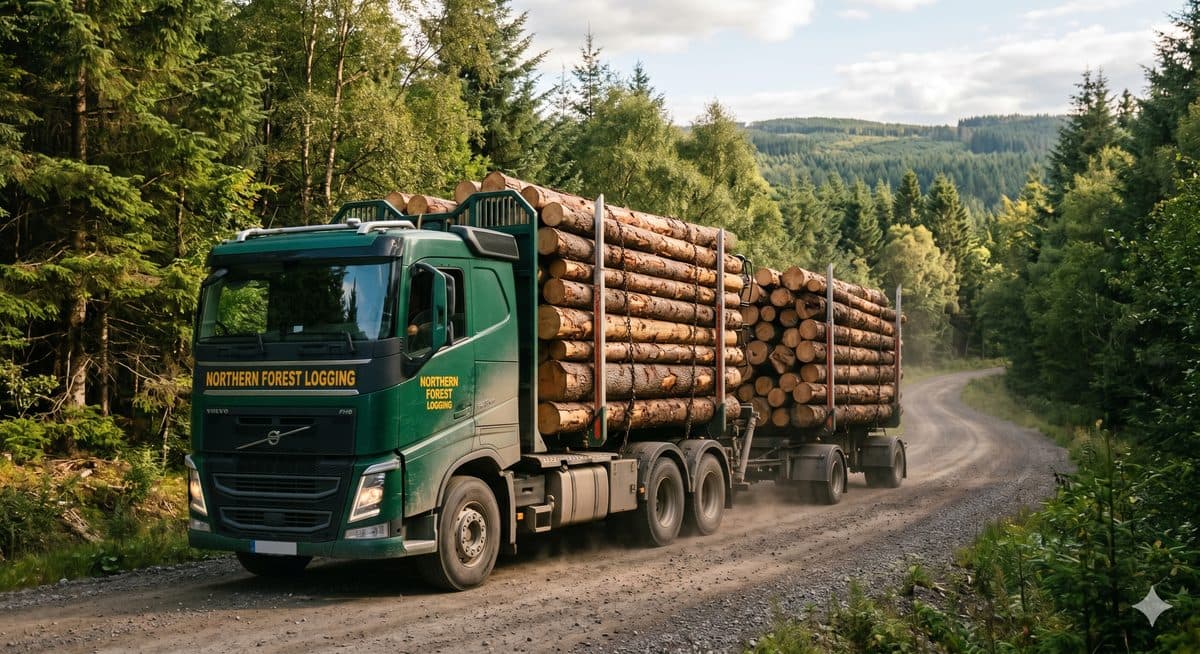
The standard logging configuration — a prime mover with a jinker (pole trailer) — is a specialist vehicle with a specific risk profile that standard HGV underwriters are not experienced in assessing. Key characteristics:
The jinker configuration allows the load (logs) to self-support between the headboard on the prime mover and the bolster on the trailing axle unit. The load is not contained — it is restrained by stanchions and load binders, and its integrity depends on correct loading and restraint. An incorrectly loaded or inadequately restrained jinker load is a log spillage incident waiting to happen.
The steep gradient risk on logging access roads means that fully loaded vehicles are operating close to their safe descent limits on downhill runs. Brake fade, overheating, and runaway incidents are known risk factors. Insurance cover for off-road and bush road operation must be explicitly included — many standard policies restrict cover to gazetted public roads.
Ready to get specialist cover?
Connect with a specialist broker — response within 24 hours.
Log Spillage Liability — The Catastrophic Exposure
A log spillage on a public road is one of the most serious liability incidents a logging carrier can be involved in. Logs weighing 500–800 kg each, rolling across a road at speed, create a catastrophic hazard for other road users. Fatalities from log spillage incidents have occurred on this country's roads.
The liability exposure from a log spillage incident includes: - Third-party vehicle damage (multiple vehicles potentially) - Bodily injury and fatality claims (through public liability) - Road clearing and reinstatement costs (NZTA or local authority) - Cargo loss (through carriers liability — the timber owner's claim) - Potential WorkSafe prosecution for load restraint failure
Given this exposure profile, public liability of at least $5,000,000 is the appropriate minimum for logging operators. Some forest owners and principal contractors require $10,000,000 PL as a condition of access. The [NZ Heavy Haulage Association](https://www.nzhha.org.nz) recommends members carry limits commensurate with their specific exposure.
Forestry Work Regulations 2017
The Forestry (Safety) Regulations 2017 set minimum safety standards for forestry operations, including logging transport. Key requirements affecting carriers include:
Safe system of work documentation, hazard identification and management, driver competency and training requirements, and vehicle safety standards. [WorkSafe NZ](https://worksafe.govt.nz) publishes forestry-specific guidance and enforces compliance through audits and incident investigations.
Ready to get specialist cover?
Connect with a specialist broker — response within 24 hours.
The forestry sector consistently records among the highest workplace fatality rates of any sector in this country. WorkSafe has prioritised forestry safety as an enforcement focus. Operators who cannot demonstrate compliance with the Forestry Regulations face elevated prosecution risk in the event of a serious incident.
Carbon Forest Expansion — A New Sector Risk
The rapid expansion of carbon forestry — conversion of farmland to native and exotic trees under the Emissions Trading Scheme — is creating new logging and access road challenges. Carbon forest operators are not primarily in the business of timber harvesting and may have less experience managing forestry access roads and the carriers who use them. As these forests mature and harvesting occurs, the road infrastructure and access management may not be at the standard of established commercial forestry operations.
Carriers accessing carbon forests on relatively undeveloped access roads face elevated vehicle damage and recovery cost exposure. Discuss this specifically with your broker if you are taking on work in carbon forest operations.
WorkSafe and the Forestry Safety Record
The forestry sector consistently records among the highest workplace fatality rates of any industry in this country. [WorkSafe NZ](https://worksafe.govt.nz) publishes annual work-related fatality statistics — forestry and logging feature prominently, with fatality rates significantly above the national average for all industries.
WorkSafe has designated forestry as a priority sector for enforcement activity. Operators who cannot demonstrate compliance with the Forestry (Safety) Regulations 2017 face elevated prosecution risk in the event of a serious incident. The financial consequences include:
Ready to get specialist cover?
Connect with a specialist broker — response within 24 hours.
- Fines under the Health and Safety at Work Act 2015 of up to $3,000,000 for organisations - Legal defence costs of $50,000–$200,000 for a WorkSafe prosecution - Potential suspension of operations during the investigation period (a business-stopping event for a carrier under volume contract)
Statutory liability insurance covers the fines and legal defence costs of WorkSafe prosecutions. For logging operators — where the fatality and serious injury risk is demonstrably higher than most other sectors — statutory liability is not optional.
Forest Road Liability and Access Agreements
One of the most significant and often overlooked exposures for logging operators is forest road reinstatement liability. Forestry access road agreements typically include carrier obligations to maintain road condition. Repeated heavy vehicle use breaks down road surfaces, requires grading, and ultimately requires significant reinstatement.
The bill for a season's logging on a major access route can reach $50,000–$200,000. Some carriers negotiate road maintenance contributions directly with forestry companies. Others face retrospective reinstatement invoices. Your insurance must explicitly include road reinstatement costs arising from your normal operations — not just road clearing following an accident.
Harvest Season Pressures and Incident Risk
The wood processing sector operates on tight margins. Mill intake schedules, port vessel ETAs, and log pricing windows create time pressure on carriers. This pressure is a known accident risk factor — carriers under time pressure to meet a vessel are less likely to stop for rest, more likely to take risks on deteriorating roads, and less likely to flag vehicle defects before a run.
Ready to get specialist cover?
Connect with a specialist broker — response within 24 hours.
Your insurance is the financial safety net when incidents occur. But your broader risk management — driver rest scheduling, vehicle inspection protocols, clear communication with mills and forests about delivery windows — reduces the incidents that generate claims and the WorkSafe investigations that follow serious incidents.
Agreed Value for Logging Trucks — Getting It Right
Logging trucks and jinker configurations are specialist assets. A well-maintained 2019 Kenworth T908 or Peterbilt 389 with a matching jinker represents $400,000–$600,000 of capital. The secondhand market for quality logging trucks is active but not transparent — agreed value must be established with reference to actual replacement cost in the current market, not generic depreciation tables.
Your broker should work with specialist HGV valuers — or obtain market evidence from specialist truck dealers — when setting agreed values for logging configurations. An agreed value that is 20% below replacement cost at claim time creates a $80,000–$120,000 gap for a typical logging unit. This is not the outcome from a policy that is supposed to protect your business.
Reassess agreed values annually — the market for quality logging trucks has moved significantly over the past three years and values that were accurate in 2022 may be substantially below current replacement cost.
Rothbury and the NZHHA Programme
The [NZ Heavy Haulage Association](https://www.nzhha.org.nz) has a preferred insurance programme through Rothbury. For logging operators who are NZHHA members, this programme provides access to specialist underwriting capacity and coverage extensions designed for heavy haulage and logging risks. Rothbury's team understands the specific load types, road conditions, and incident profiles that affect logging insurance — and can structure cover that a generalist HGV insurer would not offer.
Ready to get specialist cover?
Connect with a specialist broker — response within 24 hours.
NZHHA membership also provides access to regulatory advocacy, industry networking, and compliance guidance that has practical value beyond the insurance programme.
Industry Bodies & Associations
Represents specialist heavy vehicle operators including logging. Rothbury describes itself as a partner of the association.
MPI forestry arm — forestry regulations and safety standards.
Frequently Asked Questions
Can I get insurance for logging if I only operate on private forest roads?
Yes — though cover for off-road operations on private roads must be specifically included. Some policies restrict cover to public roads. If your operations include private forest roads, make sure your policy specifically covers these routes.
Does my logging policy cover log spillage liability?
Carriers liability covers your legal liability for the cargo (the logs) in transit. Public liability covers third-party injury or property damage caused by a log spillage. You need both — and given the severity of log spillage incidents, high limits (at least $5M PL) are appropriate.
Get a Logging & Forestry Quote
Specialist broker response within 24 hours
Sector-specialist brokers
Compare the brokers who specialise in logging & forestry insurance programmes.
Compare Brokers