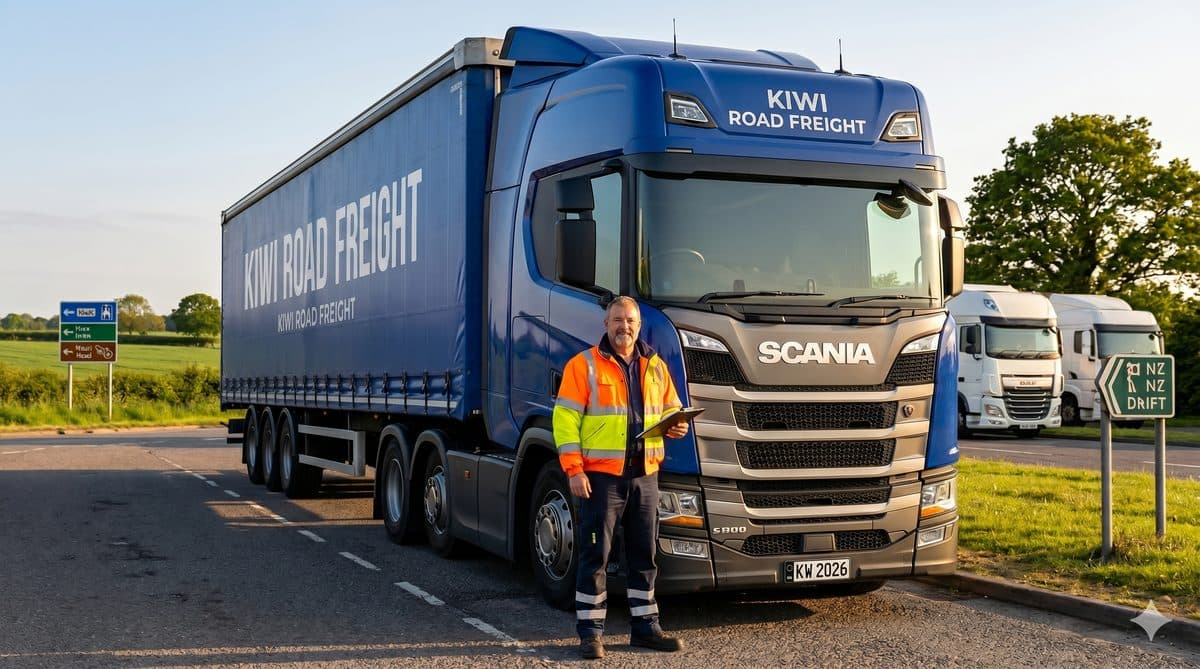
Owner-Operators Insurance
Independent owner-operators running a single truck as a business — with tailored insurance packages that protect both the vehicle and the person behind the wheel.
Coverage Needs for This Sector
Vehicle Types in This Sector
For an owner-operator, the truck is not just a business asset — it is the entire business. The income, the capital, the livelihood, and the future of the family all depend on that vehicle staying operational and generating revenue. The insurance stakes are therefore higher for owner-operators than for any other category of operator. A single uninsured write-off, an uninsured weeks-long downtime, or a personal injury without income cover can end the business — permanently.
The Owner-Operator Financial Model
Understanding owner-operator economics is essential to understanding the insurance requirements. A typical owner-operator artic configuration:
Vehicle finance: A working owner-operator's prime mover typically costs $250,000–$450,000 new, financed over 5–7 years. Monthly finance repayments are $4,000–$7,000. These payments do not stop when the truck stops earning. A trailer adds $60,000–$150,000.
Operating costs: Fuel ($1,500–$2,500/week at current diesel prices), tyres ($15,000–$30,000/year), maintenance ($20,000–$40,000/year), registration and CoF ($3,000–$5,000/year), insurance ($8,000–$20,000/year).
Gross revenue: A fully utilised owner-operator artic earns $180,000–$300,000+ per year depending on route, commodity, and contract rates.
Ready to get specialist cover?
Connect with a specialist broker — response within 24 hours.
Net operating income: After all costs, a well-managed owner-operator might net $60,000–$120,000. This is the income that funds the owner-operator's living expenses and represents the return on their capital.
This financial model has no slack. There is no employer to absorb the cost of downtime. There is no company reserve to fund unexpected expenses. Every gap in insurance coverage is a personal financial liability.
The Priority Insurance Stack
The priority order for owner-operator insurance spending is clear:
1. Agreed value comprehensive motor vehicle cover — absolute priority. The vehicle is the business. An uninsured write-off means the finance remains (the lender still gets paid) while the income source is gone. This is not survivable without agreed value cover adequate to replace the vehicle. Never compromise on agreed value — it must be set at actual replacement cost, not an underestimated figure chosen to reduce premium.
2. Downtime cover — second priority. Even with full motor vehicle cover, the repair period creates an income gap. With current parts lead times of 12–20 weeks for European trucks, that gap can be 3–5 months of zero revenue with full fixed cost obligations. At $2,000–$3,500 daily net revenue for a working artic, a four-month downtime without cover is a $240,000–$420,000 income gap. Downtime cover converts this catastrophic risk to a manageable one.
Ready to get specialist cover?
Connect with a specialist broker — response within 24 hours.
3. Carriers liability and public liability — third priority. These cover the operator's legal liability to freight owners and third parties. Without them, a cargo claim or third-party injury claim lands directly on the owner-operator personally — piercing the business structure because most owner-operators operate as sole traders or through thinly capitalised companies.
4. Personal accident and income protection — fourth priority. If the owner-operator cannot drive, the business stops. ACC covers 80% of earnings to the cap, but the cap may be below actual earnings and the lump sum death benefit is negligible. Personal accident cover provides the financial bridge that protects the family.
Operating Under Contract — What Your Agreement Requires
Most owner-operators work under contract to a principal carrier or freight company. The contract is the legal framework governing the relationship — and it typically specifies minimum insurance requirements. Common contract requirements include:
- Comprehensive motor vehicle insurance at agreed value (not market value) - Carriers liability of $500,000–$1,000,000 minimum - Public liability of $2,000,000–$5,000,000 minimum - The principal to be noted as an interested party on the vehicle policy
The interested party notation protects the principal's interest in the vehicle while it is operating under their contract — a standard commercial arrangement that costs nothing extra to add. If your contract requires it, tell your broker at inception.
Ready to get specialist cover?
Connect with a specialist broker — response within 24 hours.
[Transporting NZ](https://transportingnz.org.nz) provides guidance on standard sub-contracting arrangements and recommended insurance clauses. If you are signing a new sub-contracting agreement, having a broker review the insurance requirements before you sign is good practice.
Carriers Liability — Personal Exposure Under CCLA
Owner-operators frequently underestimate their personal exposure under the Contract and Commercial Law Act 2017. As a carrier operating under a road carrier's risk agreement, you are strictly liable for loss or damage to freight in your care — regardless of fault. A cargo claim against a principal carrier flows back to the sub-contracting owner-operator whose vehicle was carrying the goods.
If you are operating without adequate carriers liability, a cargo claim can create a personal debt that the courts will enforce against your personal assets — not just the business. For sole traders, there is no separation between business and personal liability. For owner-operators operating through a company, the limited liability protection is thin for a recently incorporated entity with minimal capital.
Carriers liability is not optional for owner-operators carrying third-party freight.
Single-Asset Dependency — The Existential Risk
The defining characteristic of the owner-operator business model is single-asset dependency. A fleet operator with five vehicles has 80% of their earning capacity intact when one vehicle is off the road. An owner-operator with one vehicle has 0% of their earning capacity when that vehicle is off the road.
Ready to get specialist cover?
Connect with a specialist broker — response within 24 hours.
This single-asset dependency means that the risk management disciplines that matter for owner-operators — vehicle maintenance, driver health, downtime cover, agreed value — are more critical than for fleet operators. There is no diversification available. The risk must be managed at the individual vehicle level.
ACC Coverage Gaps for Self-Employed Owner-Operators
Self-employed owner-operators have a specific issue with ACC that employed drivers do not face: voluntary ACC CoverPlus or CoverPlus Extra.
Under standard ACC CoverPlus, a self-employed person's weekly compensation is based on their most recent year's taxable income. If your taxable income in the prior year was low (perhaps after depreciation and vehicle expenses), your ACC compensation may be much lower than your actual income-earning capacity.
ACC CoverPlus Extra allows self-employed people to agree a weekly compensation amount with ACC in advance, regardless of actual taxable income. For owner-operators who legitimately minimise taxable income through vehicle depreciation and business expenses, CoverPlus Extra ensures the compensation figure reflects actual income-earning capacity rather than the reduced taxable figure.
Your accountant and broker should review your ACC cover structure alongside your personal accident insurance to ensure you have adequate income protection from both sources.
Ready to get specialist cover?
Connect with a specialist broker — response within 24 hours.
Inland Revenue — Contractor vs Employee Test
The Inland Revenue's worker classification test has implications for owner-operators who supply labour alongside their vehicle. If you are found to be an employee (rather than an independent contractor) of the principal carrier — based on the level of direction and control, exclusivity, and integration into the business — the tax and ACC obligations change for both parties.
The cover test implications: an employee's ACC is managed by the employer; an independent contractor manages their own ACC. Getting the classification wrong has downstream implications for ACC cover adequacy. If you are in a long-term exclusive arrangement with one principal, get advice on the classification — it affects both your tax position and your insurance structure.
GST and Insurance — Owner-Operator Tax Position
GST-registered owner-operators can generally claim the GST component of insurance premiums as an input tax credit. When a claim is paid, the GST treatment depends on the claim type — your accountant or tax adviser can confirm the correct treatment. This detail matters for agreed value claims: if the agreed value includes GST, the GST component may need to be excluded from the insured value or your input tax credit claim adjusted accordingly.
Building Toward a Fleet — The Growth Path
Many successful fleet operators started as owner-operators. The disciplines that make a successful owner-operator — meticulous vehicle maintenance, careful driving, rigorous financial management, strong client relationships — are exactly the disciplines that build a successful fleet.
The insurance programme should grow with the business. Adding a second vehicle means the programme can move from an individual policy to an early fleet structure — with the administrative efficiency and coverage coordination that brings. Adding a third and fourth vehicle makes a formal fleet policy worthwhile. At five or more vehicles, fleet policy structures deliver genuine economies of scale in both coverage and administration.
Ready to get specialist cover?
Connect with a specialist broker — response within 24 hours.
As you grow, the coverage complexity also grows: additional drivers, multiple trailers, more varied routes and cargo types. A specialist HGV broker who understands both the owner-operator phase and the fleet growth phase is a long-term business relationship worth investing in — not just a commodity transaction renewed annually on price.
The Mental Health Dimension
Owner-operator trucking is physically and mentally demanding. Long hours, time away from family, the financial pressure of vehicle finance, the isolation of long-haul routes, and the constant uncertainty of contract security all contribute to elevated mental health risk. The transport sector has recognised this — [Transporting NZ](https://transportingnz.org.nz) and industry bodies have invested in mental health awareness and support resources for their members.
From an insurance perspective, mental health conditions are not covered by standard personal accident insurance (which covers accidental physical injury). Income protection insurance — which covers inability to work from any cause, including mental health conditions — is a separate and complementary product. Owner-operators who are serious about protecting their business against all income loss scenarios should discuss income protection alongside personal accident cover with their broker.
Industry Bodies & Associations
Represents owner-operators and smaller carriers. Preferred insurance programme through Marsh NZ.
Road transport operator body with Gallagher NZ preferred programme accessible to owner-operators.
Frequently Asked Questions
Can I get a combined package that covers everything in one policy?
Yes — specialist HGV brokers can package vehicle, carriers liability, public liability, downtime, and personal accident into a single owner-operator programme. A single policy with coordinated covers is simpler to manage and ensures no gaps between separate policies.
Do I need to tell my insurer which principal I'm contracted to?
Yes — if you are operating predominantly for one principal carrier, this is material information that affects the risk profile (the principal's freight, their routes, their scheduling practices all affect your exposure). Disclose the arrangement to your broker.
Get a Owner-Operators Quote
Specialist broker response within 24 hours
Sector-specialist brokers
Compare the brokers who specialise in owner-operators insurance programmes.
Compare Brokers