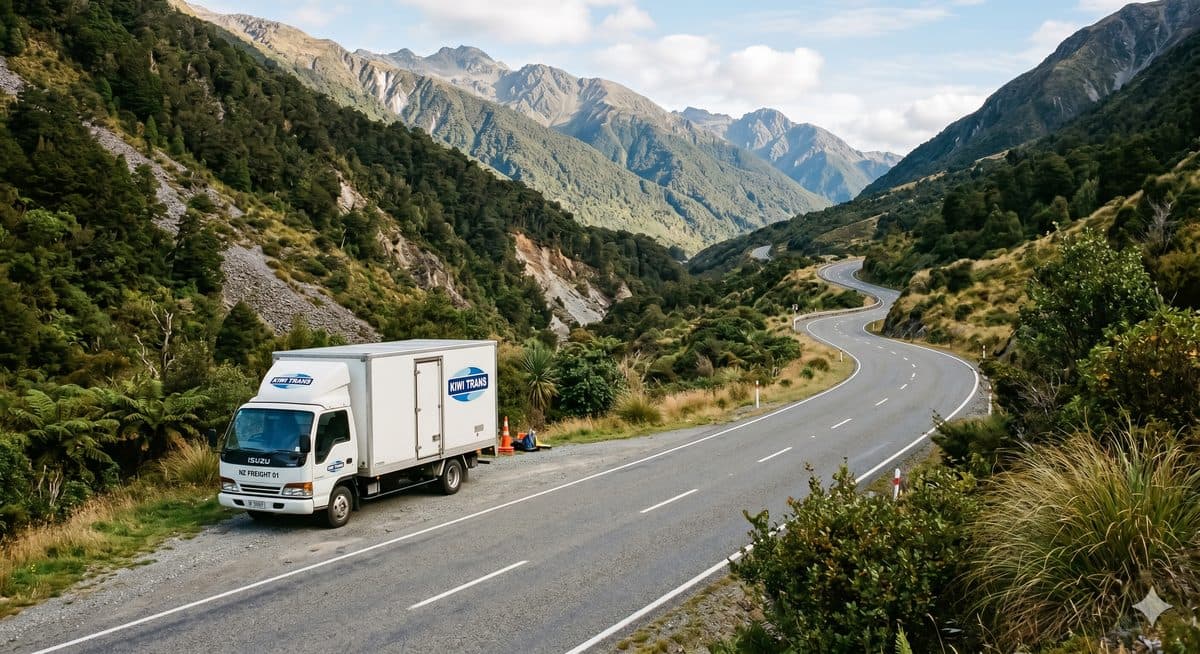
Wellington HGV Insurance
Wellington sits at the gateway to the Cook Strait ferry routes, making it a critical link in inter-island freight and a major hub for North Island distribution.
🏭 Key Industries
- ✓Inter-island ferry freight
- ✓Government/public sector logistics
- ✓Refrigerated distribution
- ✓Construction
🛣️ Key Routes
Wellington's position at the southern tip of the North Island gives it a unique role in the national freight network. It is simultaneously a major employment and freight destination in its own right, and the gateway through which all road freight moving between the islands must pass. For heavy vehicle operators based in Wellington, or running freight to and from the capital, the specific risks of this operating environment require equally specific insurance.
Cook Strait ferry operations — the inter-island freight chain
Every artic, rigid truck, or livestock carrier crossing between the North and South Islands does so via the Cook Strait ferry — either Interislander or Bluebridge, both operating from Wellington Harbour's Aotea Quay and CentrePort. The ferry crossing is itself an interruption to the road freight journey: vehicles are driven on and secured on the vehicle deck, the vessel crosses (roughly 3 hours to Picton), and vehicles are driven off to continue their journey.
Ferry terminal insurance requirements apply at Aotea Quay. Operators must have current vehicle and liability cover as a condition of ferry booking. The crossing itself — when your vehicle is on the vessel — is a period when your vehicle insurance should specifically note the ferry transit. Most specialist HGV policies include this, but it is worth confirming with your broker that your policy has no exclusion for maritime transit as a passenger on a domestic ferry.
The ferry connection also creates a schedule dependency that has insurance implications. A vehicle delayed by ferry cancellation (weather, vessel breakdown) or mechanical failure in Picton or Wellington may be stranded for 12-24 hours. Downtime cover that pays during ferry-related delays is worth discussing with your broker.
Remutaka Hill — one of the North Island's most demanding routes
SH2 over the Remutaka Range is one of the most challenging heavy vehicle routes in the lower North Island. The gradient on the Wellington side is sustained and steep, with tight corners that require low-gear descents and careful brake management. Frost and ice form regularly on the upper sections in winter — black ice on a steep descent is a genuine hazard, and the Remutaka has seen serious heavy vehicle incidents over the years.
Ready to get specialist cover?
Connect with a specialist broker — response within 24 hours.
Operators running over the Remutaka should ensure their vehicle is properly maintained for the grade — brake systems, tyre condition, and engine braking capability are critical. From an insurance perspective, a history of brake-related incidents on mountain routes will attract scrutiny at renewal. Investing in electronic stability control, exhaust brakes, and retarder systems not only reduces risk but demonstrates to underwriters that you are a quality risk.
The alternative to Remutaka for some freight flows is SH2 through Masterton (approaching from the north), which adds distance but avoids the range. Operators with time-sensitive freight may not have this option.
Wellington CBD delivery restrictions
Wellington's compact CBD has significant heavy vehicle restrictions. Loading zone time limits, narrow streets (particularly in the older parts of the CBD and Te Aro), and the Thorndon Overbridge weight limits all affect routing. The Wellington City Council heavy vehicle bylaw restricts certain vehicle configurations to specific routes and time windows.
For construction truck operators, Wellington's seismic activity context creates an additional layer. Post-earthquake strengthen and rebuild projects have been ongoing since 2016, with significant volumes of construction truck activity in the CBD, Thorndon, and Petone. These urban construction environments involve pedestrian and cyclist proximity, and the frequency of minor incidents is elevated accordingly.
Earthquake-prone zone — construction logistics
Wellington is one of New Zealand's highest seismic risk zones. The ongoing strengthening and rebuild of commercial buildings means that construction trucks are a constant presence in the Wellington urban environment. For operators working on these projects, the combination of tight CBD access, heavy vehicle restrictions, and proximity to the public creates a risk profile that requires specific underwriting discussion. Public liability limits of $2 million minimum are standard for Wellington construction freight operators, and many projects require $5 million minimum.
Ready to get specialist cover?
Connect with a specialist broker — response within 24 hours.
A specialist broker with Wellington experience understands the city's unique geography and regulatory environment — and can structure your cover to match it.
Common Vehicle Types in Wellington
Click any vehicle type to explore specialist cover options and coverage requirements.
Frequently Asked Questions — Wellington
Is my vehicle covered while it is on the Cook Strait ferry?
Most specialist HGV policies cover your vehicle during domestic ferry crossings, but you should confirm this explicitly with your broker. The vehicle should be noted as operating on domestic inter-island ferry routes. The ferry operator also carries marine liability, but this does not replace your own vehicle cover.
What are the insurance implications of the Remutaka Hill route?
Insurers consider the Remutaka Hill a rated route given its gradient and frost risk. Brake maintenance, tyre condition, and driver experience on mountain routes are factors in underwriting. A well-maintained vehicle and experienced driver should not attract a significant loading, but disclosure of the route is important.
Do Wellington construction freight operators need higher public liability limits?
Yes. Most Wellington CBD construction sites require minimum public liability limits of $2M-$5M as a site entry condition. For ongoing construction contracts, your broker should review the principal's insurance requirements and ensure your policy meets them.
Get a Quote — Wellington
Specialist broker response within 24 hours
Other Locations
Specialist Brokers
Connect with brokers who know the Wellington freight market and can structure cover for your operation.
Compare Brokers