Bulk Liquid & Tanker Operations Insurance
Fuel tankers, milk tankers, water carriers, and chemical transport operators with specialist hazardous goods and environmental liability requirements.
Coverage Needs for This Sector
Vehicle Types in This Sector
Bulk liquid transport — fuel distribution, dairy collection, chemical delivery, and water haulage — has insurance requirements that differ substantially from general freight. The liquid cargo itself creates environmental, safety, and third-party liability exposures that require specialist insurance treatment. A standard HGV policy does not address these risks adequately.
The Dairy Tanker Network — Fonterra, Synlait, Westland Milk
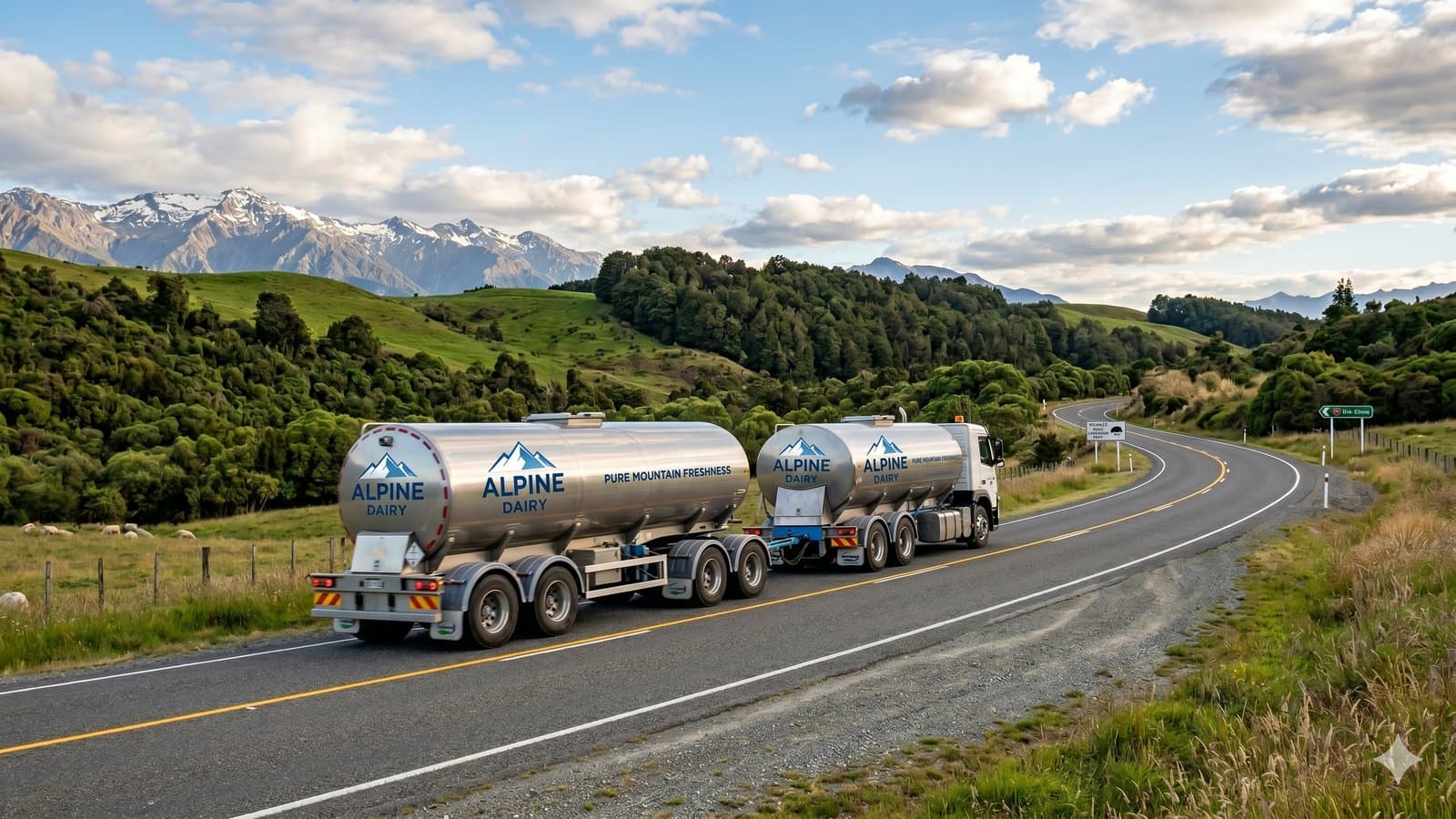
Milk tanker operators sit at the heart of the dairy supply chain. Fonterra, Synlait, and Westland Milk Products (Yili) depend on reliable daily collection circuits to maintain milk quality and processing plant throughput. A milk tanker that is off the road creates immediate supply chain disruption — farmers cannot store milk beyond the next collection cycle, and processing plants without adequate milk intake cannot maintain production schedules.
The route network for dairy collection is extensive. Fonterra alone collects from approximately 8,000 farms across the country, with collection circuits radiating from processing plants at Edgecumbe, Tirau, Morrinsville, Frankton, Pahiatua, Lichfield, Hautapu, Clandeboye (Temuka), and Westland. Individual circuits may cover 200–400 km per trip, with multiple farm gate stops.
Vehicle values for milk tanker units are substantial: a tanker unit (stainless steel insulated food-grade tank body on an artic chassis) typically costs $300,000–$500,000. Agreed value cover — not market value — is essential given these figures.
MPI compliance requirements for dairy transport include tanker hygiene standards, milk temperature specifications, and documentation requirements for each collection. [MPI](https://mpi.govt.nz) audits dairy collection operations as part of the broader food safety regulatory framework. Non-compliance can result in MPI enforcement action and potential suspension from the dairy supply chain — a business-stopping consequence.
Ready to get specialist cover?
Connect with a specialist broker — response within 24 hours.
Fuel Tanker Operations — ADG Code and HSNO
Fuel tanker operators deliver diesel, petrol, and aviation fuel from terminals to agricultural, industrial, and commercial customers. The regulatory framework for fuel transport involves multiple overlapping requirements:
HSNO (Hazardous Substances and New Organisms Act 1996): Petroleum products are classified as HSNO Class 3 (flammable liquids). Transport of HSNO Class 3 substances above threshold quantities requires placarded vehicles, trained drivers with HSNO handlers certificates, emergency response documentation, and specific vehicle standards.
Waka Kotahi NZTA ADG Code: The [Waka Kotahi NZTA](https://transport.govt.nz) dangerous goods transport requirements (based on the Australian Dangerous Goods Code) govern placarding, vehicle standards, load segregation, and documentation for dangerous goods movements by road. Fuel tanker operators must comply with these requirements on every trip.
Driver certification: Drivers of placarded dangerous goods vehicles must hold the relevant endorsement on their driver licence (F endorsement for fuel tankers). An unendorsed driver operating a placarded vehicle is both a compliance breach and an insurance coverage risk — undisclosed non-compliance can affect claim outcomes.
Tanker Rollover — The Catastrophic Scenario
A tanker rollover is the most serious incident type in bulk liquid transport. A fully laden fuel tanker carries 20,000–30,000 litres of fuel. A rollover that breaches the tank releases this fuel onto the road surface, into stormwater drains, and potentially into waterways.
Ready to get specialist cover?
Connect with a specialist broker — response within 24 hours.
The cost of a serious tanker rollover:
Road clearing and traffic management: $50,000–$150,000
Specialist hazmat contractor for fuel recovery from the road surface: $30,000–$80,000
Soil remediation (fuel-contaminated soil removal and disposal): $50,000–$200,000
Waterway contamination response (if fuel reaches a drain or waterway): $100,000–$500,000+
NZTA road surface reinstatement: $30,000–$100,000
Ready to get specialist cover?
Connect with a specialist broker — response within 24 hours.
Regional council enforcement costs and remediation monitoring: $20,000–$80,000
Total: $280,000–$1,100,000+ for a serious fuel tanker rollover involving waterway contamination.
Without specific environmental liability and pollution liability insurance, these costs fall directly on the operator.
Environmental Liability — The Mandatory Extension
Standard public liability policies typically exclude gradual pollution and may restrict coverage for sudden pollution events, or include sub-limits that are inadequate for a serious tanker incident. For fuel tanker, chemical tanker, and effluent tanker operators, a specific environmental liability and pollution liability policy section or standalone policy is not optional.
The Resource Management Act 1991 (RMA) gives regional councils powers to require immediate remediation of pollution incidents, recover remediation costs from the responsible party, and impose ongoing monitoring obligations. RMA enforcement costs — even before remediation begins — can be substantial.
Ready to get specialist cover?
Connect with a specialist broker — response within 24 hours.
HSNO enforcement by WorkSafe NZ for serious hazardous substance incidents adds another cost layer: investigation, expert witness fees, and potential statutory fines.
Dairy Effluent Tankers — A Specific Risk
Dairy effluent tankers — carrying effluent from farm storage ponds to disposal fields — present a specific biosecurity and environmental risk distinct from milk transport. Effluent spillage on public roads creates a contamination and biosecurity hazard. The biohazard cleaning required after an effluent spill is specialist work. Regional council enforcement for effluent spills in sensitive areas (near waterways, drains, or public land) is active.
Effluent tanker operators require explicit public liability and environmental liability cover that addresses the specific characteristics of the cargo.
Chemical Tanker Operations — Specialist Underwriting Required
Chemical transport sits at the specialist end of the tanker market. Operators carrying corrosive (HSNO Class 8), toxic (Class 6), or reactive substances face the most demanding compliance requirements, the most specialised vehicles (lined tanks, pressure vessels, specialist valving), and the most severe incident consequences.
Standard insurance markets will typically decline chemical tanker risks. Lloyd's of London capacity, accessed through specialist brokers, provides the primary market for dangerous chemical transport. Obtaining cover requires detailed information about the specific chemicals carried, transport routes, vehicle specifications, driver training, and emergency response arrangements.
Ready to get specialist cover?
Connect with a specialist broker — response within 24 hours.
Temperature-Controlled Tankers
Some bulk liquid products require temperature-controlled transport — asphalt and bitumen (hot tankers), liquid chocolate and food-grade oils (heated food tankers), and certain chemical products requiring temperature maintenance. These vehicles carry heating systems and insulation in addition to the tank body, adding to vehicle value and complexity.
Refrigeration failure cover equivalent (temperature maintenance failure causing product loss) requires explicit extension — standard carriers liability does not automatically address temperature-control failure for liquid cargo.
Fleet Values and Agreed Value — Non-Negotiable
The agreed value requirement is more critical in the tanker sector than almost anywhere else in the heavy vehicle market. Tanker units are among the most expensive vehicles on the road: a stainless steel food-grade milk tanker is $300,000–$500,000; a fuel tanker unit is $250,000–$400,000; a specialist chemical tanker can exceed $600,000.
These values are not captured by standard HGV depreciation tables. A five-year-old milk tanker body in good condition retains close to full value — the stainless steel construction, food-grade certification, and specialist nature of the asset mean it does not depreciate at the same rate as a general freight body. An insurer applying standard depreciation to a tanker body will significantly undervalue the asset at claim time.
Work with your broker to establish agreed values for each tanker unit that reflect actual replacement cost — including the tank body, chassis, plumbing, pump systems, and any electronic metering equipment. Review agreed values at each annual renewal.
Ready to get specialist cover?
Connect with a specialist broker — response within 24 hours.
Synlait and Westland Milk — Supply Chain Contract Obligations
Dairy processors including Fonterra, Synlait, and Westland Milk Products (Yili) operate under formal milk supply agreements that create obligations on collection contractors. If a collection vehicle failure results in a missed collection — a farmer whose milk cannot be collected before the next milking — the processor may face a contractual obligation to the farmer, and the collection contractor faces a claim from the processor.
Downtime cover for milk tanker operations should include a contractual penalty extension that covers the costs the operator is liable for when a vehicle breakdown results in a failed collection. Standard downtime cover pays the daily benefit but may not specifically address contractual penalties under supply agreements. Discuss this with your broker if you operate under a formal collection contract.
RMA Spill Liability — Regional Council Enforcement
Regional councils enforce the Resource Management Act 1991 with respect to water quality, soil contamination, and air quality. A fuel, chemical, or dairy waste spill that reaches a waterway triggers regional council jurisdiction immediately. Under the RMA, regional councils can:
- Issue an enforcement order requiring immediate remediation - Appoint their own contractors to remediate and recover costs from the responsible party - Prosecute the responsible party for RMA offences (fines up to $600,000 for organisations for serious water quality offences) - Require ongoing monitoring of the affected site at the operator's cost
The combination of RMA remediation costs, monitoring obligations, and potential prosecution fines is the primary environmental liability exposure for tanker operators. Environmental liability insurance covering sudden and accidental pollution — and the RMA response costs that follow — is essential for any bulk liquid operator.
Ready to get specialist cover?
Connect with a specialist broker — response within 24 hours.
Incident Response Planning for Tanker Operators
Tanker operators should have a documented incident response plan that covers the actions to take in the first minutes after a spill or accident. Key elements:
Immediate notification: Regional council spill hotline (0800 numbers are published by all regional councils), NZTA for State Highway incidents, NZ Fire Service for fires involving hazardous cargo. Many liquid spills require notification to multiple agencies simultaneously.
Product data sheets: HSNO and dangerous goods requirements include carrying Safety Data Sheets (SDS) for the products being transported. In the event of a spill, emergency responders need immediate access to the SDS to understand hazard profiles and containment requirements.
Insurer notification: Contact your insurer's emergency response line immediately. Many specialist tanker policies include 24/7 emergency response services — connecting you with environmental response contractors and legal advisers at the moment you need them.
Having a documented, practiced response plan reduces the chaos of a serious incident, speeds up containment (which reduces remediation costs), and demonstrates to your insurer and regulators that you manage your operations responsibly.
Ready to get specialist cover?
Connect with a specialist broker — response within 24 hours.
Industry Bodies & Associations
Regulates hazardous substances including petroleum products under HSNO.
Dairy sector body — relevant for milk tanker operators working in dairy supply chains.
Frequently Asked Questions
Do I need separate environmental liability or is it included in public liability?
Standard public liability policies typically exclude or limit pollution-related claims. For tanker and bulk liquid operators, a specific environmental liability or pollution liability extension — or a standalone pollution liability policy — is required. Do not assume your PL policy covers fuel or chemical spill remediation.
What happens if my fuel tanker is involved in an accident and fuel contaminates a waterway?
The regional council has powers under the RMA to require immediate remediation. The costs — specialist contractors, water quality testing, ongoing monitoring — can run to hundreds of thousands of dollars. Environmental liability insurance covers these costs. Without it, the cost comes directly out of your business.
Get a Bulk Liquid Quote
Specialist broker response within 24 hours
Sector-specialist brokers
Compare the brokers who specialise in bulk liquid insurance programmes.
Compare Brokers