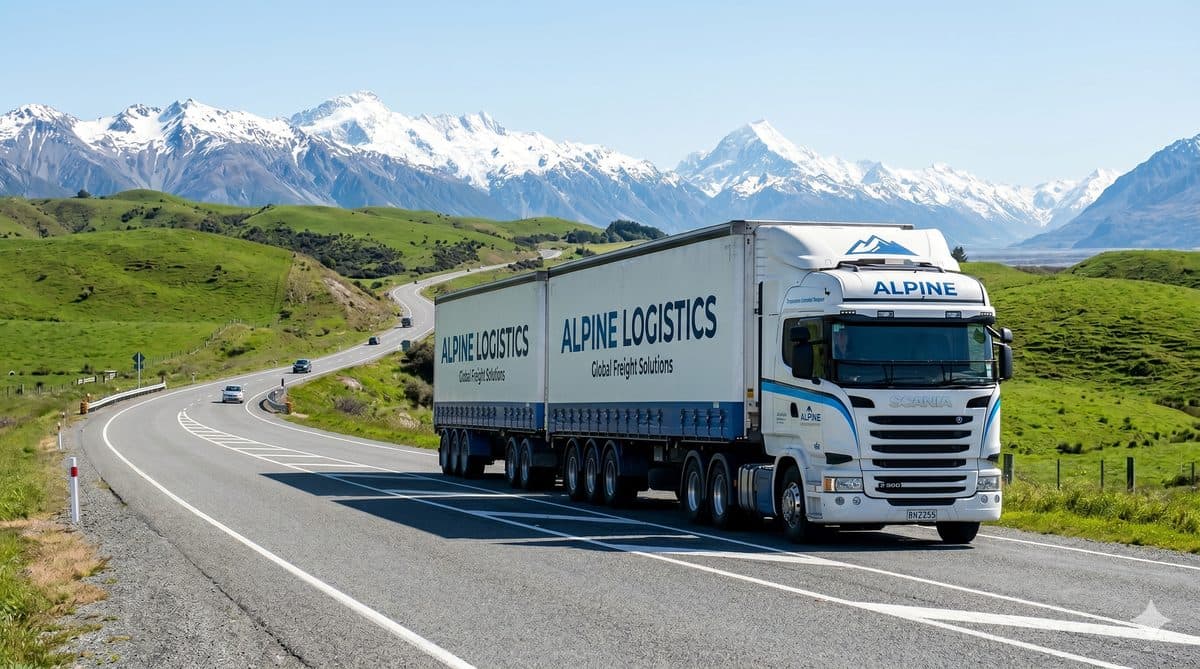
Articulated Trucks & Semi-Trailers Insurance
Comprehensive cover for artic units, prime movers, and semi-trailer combinations carrying general freight across the country.
⚠️ Key Risks
- •High replacement cost for late-model prime movers
- •Cargo liability for goods in transit
- •Rollover and jackknife incidents on alpine passes
- •Fuel and tyre theft at rest areas
- •Multi-vehicle pile-ups on State Highway 1
✓ Coverage Checklist
- ✓Comprehensive motor vehicle cover
- ✓Carriers liability (goods in transit)
- ✓Public liability
- ✓Downtime / loss of use
- ✓Road clearing and reinstatement costs
- ✓Personal accident for driver
- ✓Tyre and rim damage
Articulated trucks — artics, prime movers, semi-trailers — are the backbone of long-haul freight in this country. Running the Palmerston North to Auckland corridor on State Highway 1, crossing the Remutaka Range on SH2, hauling refrigerated product overnight from Invercargill to Christchurch, or fighting the Lewis Pass in winter — these vehicles earn their keep in conditions that test both driver and machine every single day.
With gross combination masses (GCM) up to 44 tonnes, an articulated truck and loaded trailer represents an asset worth anywhere from $180,000 to well over half a million dollars new. When you add the value of the freight on board — perishables, building materials, retail merchandise, dairy product, or high-value electronics — the total exposure on any single run can be enormous. Getting the insurance structure right is not a nice-to-have; it is a fundamental business obligation that protects the entire enterprise.
Why Standard Motor Vehicle Insurance Fails Artic Operators
A standard private motor vehicle policy does not cover commercial use. Even a standard commercial vehicle policy designed for light vans or utes will have exclusions, restricted-use clauses, and sub-limits that leave artic operators dangerously underinsured. Specialist HGV insurance is structured around the real risks of heavy haulage, and there is no shortcut to getting it right.
The motor vehicle section covers loss or damage to the prime mover and trailer: fire, theft, storm, flood, collision, and accidental damage. For newer units, agreed value cover locks in the replacement cost rather than leaving you exposed to depreciation arguments at claim time. In a market where late-model Scania, Kenworth, MAN, and Volvo prime movers carry delivery lead times of 12 to 18 months, agreed value is not optional — it is the only way to guarantee business continuity after a write-off.
Carriers liability is the critical extension every artic operator running third-party freight must carry. Under the Contract and Commercial Law Act 2017 (CCLA), carriers operating under a road freight arrangement have a legal duty of care for goods in transit. If a consignment of dairy products spoils because a refrigeration unit failed, or pallets of electronics are destroyed in a rollover, carriers liability pays the freight owner's loss. Policy limits typically run from $250,000 to $2,000,000 per load. Your broker will size this to the type and value of freight you carry — a general merchandise operator and a high-value electronics carrier need very different limits.
Ready to get specialist cover?
Connect with a specialist broker — response within 24 hours.
Road Clearing and Reinstatement Costs
These costs are consistently underestimated by operators who have never experienced a serious incident. A significant artic rollover on State Highway 1 south of Auckland, on the Desert Road between Waiouru and Turangi, or on SH58 approaching Wellington, can close the road for 12 to 24 hours. [Waka Kotahi NZTA](https://transport.govt.nz) and local roading authorities bill the responsible carrier for signage deployment, barriers, crane hire, specialist heavy recovery vehicles, environmental cleanup, and road surface repair. These invoices exceed $80,000 in moderate incidents and top $150,000 on complex motorway closures — and they are not covered by your motor vehicle section unless road clearing cover is specifically added.
The [National Road Carriers Association](https://natroad.co.nz) has documented multiple cases where member operators received NZTA reinstatement invoices running well into six figures. NRC members should ask their broker specifically about road clearing limits and whether the cover meets any minimum requirements specified in their principal contracts. The right minimum is generally $250,000; $100,000 is increasingly inadequate for high-speed highway incidents.
Downtime and Loss of Use
Downtime cover pays a daily benefit while your truck is off the road for covered repairs. A late-model artic running general freight on the SH1 corridor between Auckland and Christchurch generates $1,500 to $3,000 in daily revenue. An engine rebuild or a cab replacement after a serious collision can take eight to fourteen weeks. At $2,000 per day, fourteen weeks of downtime is $196,000 in lost revenue — a sum that would push most small operators to the edge without cover in place.
The daily rate must reflect your actual average daily net earnings, not an aspirational figure. Insurers check against financial statements, and over-insuring is both wasteful and potentially problematic at claim time. Review the downtime rate at every renewal; as your freight rates change, so does the cover you need.
Driver Personal Accident Cover
Driver personal accident cover pays a lump sum or weekly benefit if your driver — or you, if you are an owner-operator — is seriously injured or killed on the job. It sits alongside ACC and compensates where the Accident Compensation scheme has gaps. The Health and Safety at Work Act 2015 (HSW Act) places explicit obligations on employers as persons conducting a business or undertaking (PCBU) to manage workplace health and safety risks. Having personal accident cover in place both protects your drivers and their families and demonstrates your commitment to those HSW Act obligations.
Ready to get specialist cover?
Connect with a specialist broker — response within 24 hours.
[WorkSafe NZ](https://worksafe.govt.nz) investigates serious heavy vehicle incidents. If a driver is killed or seriously injured, WorkSafe will examine your safety systems, your fatigue management programme, your vehicle maintenance records, and your compliance with the Land Transport Act 1998. A documented, well-managed safety programme reduces both the risk of incidents and the regulatory consequences when one occurs.
The ACC weekly compensation cap — approximately $2,400 per week at current settings — means drivers earning above this threshold will not have their income fully replaced by ACC alone. A top-up income protection policy bridges this gap during recovery, ensuring your driver can focus on rehabilitation rather than financial survival.
Tyre and Rim Damage
Tyre and rim damage is a significant cost centre for artic operators on high-kilometre routes. Road debris on SH1 between Auckland and Hamilton, pothole strikes on SH3 through the King Country, and gravel road excursions can destroy a tyre worth $600 to $1,200 per unit. With 18 or more tyres on a typical artic combination, a single bad incident can generate $5,000 to $10,000 in tyre replacement costs. Many policies exclude tyre damage as mechanical failure or wear; specialist HGV cover addresses this specifically. Confirm with your broker exactly which tyre and rim events are covered and what the per-incident policy limit is.
Fleet Operators and Multi-Unit Policies
Running three or more artics — general freight, refrigerated, or specialised loads — means a fleet policy typically delivers better premium efficiency than separate policies per vehicle. Fleet rates are calculated on burning cost (your total claims experience), creating a direct financial incentive to invest in driver training, telematics, and preventive maintenance.
[Transporting NZ](https://transportingnz.org.nz) runs preferred insurance programmes through specialist brokers. As a Transporting NZ member you may access preferred fleet terms and coverage extensions not available in the standard market. The [National Road Carriers Association](https://natroad.co.nz) has similar broker relationships that benefit member operators at renewal.
Ready to get specialist cover?
Connect with a specialist broker — response within 24 hours.
Some insurers require a Fleet Risk Management Assessment before issuing a fleet quote. Operators who engage seriously with this process — documenting their safety systems, showing evidence of driver training, presenting telematics data — consistently attract better premiums than those who resist scrutiny. Specialist brokers like Rothbury and Gallagher NZ have dedicated fleet teams that manage the assessment process efficiently and advocate for operators in the underwriting conversation.
Getting the Sum Insured Right
The most consistent mistake artic operators make is setting their sum insured on depreciated book value rather than actual replacement cost. A six-year-old Kenworth T610 might sit at $120,000 on the depreciation schedule — but replacing it with an equivalent unit today, factoring in the secondhand market premium caused by new-truck supply constraints, might cost $200,000 or more. An agreed value policy removes this uncertainty entirely and puts a figure in the schedule that everyone understands before a claim occurs.
Your broker should review agreed values annually at renewal. Truck values have moved significantly in recent years as supply chain constraints on European and North American manufacturer production have pushed secondhand prices well above historic norms. What was correctly insured two years ago may leave you materially underinsured at the next renewal.
The SH1 Corridor and Alpine Route Risk
The SH1 corridor — from Auckland through the Waikato, past Taupo, across the Rangipo Desert, through Palmerston North, and over the Remutaka Range into Wellington — carries the highest volume of heavy vehicle freight in the country and generates the highest frequency of serious artic incidents. Underwriters know this route well. Expect questions about driver experience on SH1, fatigue management systems, and load restraint practices.
SH6 on the West Coast from Haast to Hokitika, SH73 over Arthur's Pass, and SH94 through Fiordland present extreme alpine conditions that require specific risk management. Tight bends, no barriers, sheer drops, and rapidly changing weather conditions make these routes a different risk class to motorway haulage. If your operation uses these routes regularly, be transparent with your broker — the right insurer for alpine route exposure may not be the cheapest mainstream quote, and the wrong policy will let you down at the worst moment.
Ready to get specialist cover?
Connect with a specialist broker — response within 24 hours.
Theft and Security at Rest Areas
Fuel and tyre theft from resting artics is a growing problem at key rest areas on SH1 and SH2. A full tank of diesel on a late-model prime mover is worth $1,000 to $1,800 at current prices. Tyres and rims left unlocked are regularly targeted. High-value cargo — electronics, pharmaceuticals, clothing — is the primary theft target, and cargo theft is a carriers liability event that your policy must cover. Discuss security requirements with your broker; some insurers apply loading for vehicles that regularly park unsecured overnight in known theft hotspots.
The Remutaka and Alpine Pass Protocols
The Remutaka Hill Road on SH2 — one of the most trafficked artic routes between the Wairarapa and Wellington — has a documented heavy vehicle incident history, particularly in wet weather and during periods of strong westerly wind. The gradient, the tight bends, and the exposed ridgeline section combine to create conditions that demand specific driver protocols. Insurers are aware of the Remutaka's incident frequency and will ask about your driver protocols, the condition of your braking systems, and your chain-of-contact procedures for mountain road conditions.
Arthur's Pass on SH73, the Desert Road on SH1 between Waiouru and Turangi in winter conditions, and the Lindis Pass on SH8 in Central Otago all present similar conditions at different times of year. Operators who can demonstrate that their drivers have specific route training and that inclement weather protocols are followed — including turnaround decisions — present materially better risk to underwriters than those who rely on driver judgment alone.
Agreed Value Review — Annual Discipline
The discipline of reviewing agreed values at every renewal is more important for artic operators than almost any other vehicle category, because the values involved are so large and the gap between depreciated book value and actual replacement cost can be so significant. A Scania R730 new-generation prime mover that was correctly insured at $320,000 three years ago may cost $400,000 or more to replace today — not because the truck has appreciated in value, but because the new-truck price has risen and the secondhand market for late-model Scania and Kenworth units is thin and competitive.
Make agreed value review a standing agenda item at every broker renewal meeting. Bring your current market intelligence — recent advertised prices for equivalent units, any dealer quotes you have received, or NZTA registration data for comparable vehicles — and use it to inform the agreed value conversation. An underinsured artic is a business risk that is entirely preventable.
Ready to get specialist cover?
Connect with a specialist broker — response within 24 hours.
To connect with a specialist broker for articulated truck insurance, complete the quote request on this page and expect a response within 24 hours.
Frequently Asked Questions
Does my artic policy cover the trailer as well as the prime mover?
It depends on the policy structure. Many insurers write prime mover and trailer as a combined unit, but if you use multiple trailers or swap trailers between operators, each trailer may need separate cover. Always declare all trailers to your broker.
What is carriers liability and do I need it?
If you carry goods belonging to someone else, carriers liability is essential. Under the Contract and Commercial Law Act 2017, you have legal responsibility for goods in your custody. Carriers liability covers you if the freight is lost, damaged, or destroyed while in your care.
How much road clearing cover do I need?
Waka Kotahi NZTA and local road authorities can invoice $50,000–$150,000 for a serious motorway incident. We recommend a minimum of $100,000 road clearing limit, and many operators carry $250,000+ especially on high-speed routes like SH1.
Can I insure an imported secondhand unit?
Yes, though insurers will want an engineering assessment for older imported vehicles. Age, make, and modification history affect premium rating. A specialist broker can source markets for vehicles that mainstream insurers decline.
Get a Articulated Trucks Quote
Specialist broker response within 24 hours
Related Coverage Types
Specialist Brokers
Access the brokers who specialise in articulated trucks insurance.
Compare Brokers