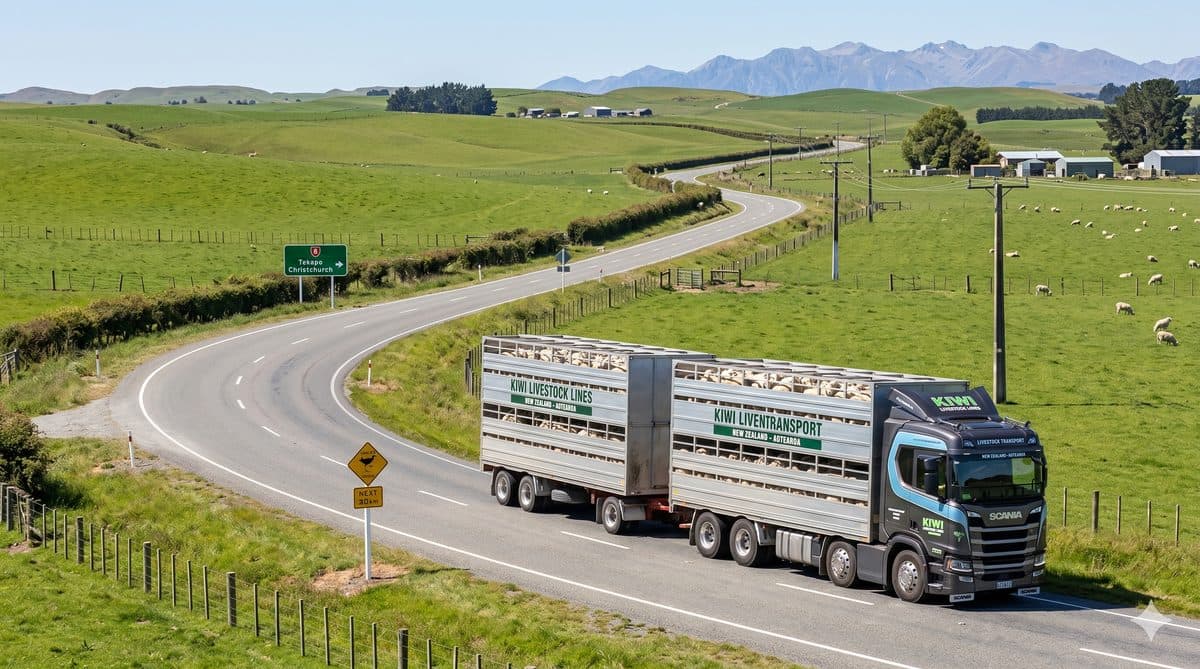
Livestock Carriers & Animal Transport Insurance
Specialist insurance for livestock trucks, cattle trucks, sheep carriers, and horse floats operating on rural and state highways.
⚠️ Key Risks
- •Animal mortality in transit — heat stress, injury, suffocation
- •Rollover with live animal cargo — complex recovery
- •Odour and contamination liability at incidents
- •Biosecurity breach liability — disease spread
- •Rural road conditions and fatigue on long hauls
- •Loading ramp injuries to handlers
✓ Coverage Checklist
- ✓Comprehensive motor vehicle cover
- ✓Livestock mortality in transit
- ✓Carriers liability — live cargo
- ✓Public liability
- ✓Cleanup and decontamination costs
- ✓Personal accident for driver and handlers
- ✓Downtime and loss of use
Livestock transport is one of the most complex niches in the heavy vehicle insurance market — and one of the most personally demanding. The cargo is alive, which creates animal welfare obligations, biosecurity compliance requirements, and insurance considerations that simply do not exist in any other freight category. Getting the coverage right requires a broker who understands the insurance market, the Animal Welfare Act 1999, the MPI livestock transport standards, and the operational realities of the pastoral sector.
The agricultural sector depends completely on reliable livestock transport. Cattle, sheep, deer, and horses move between farms, to saleyards, to processing plants, and across regions every day throughout the country. This movement is both time-sensitive and condition-sensitive: a delayed livestock consignment can mean animals miss a saleyard market day in Feilding or Hawera, arrive at a Southland or Canterbury processing plant in poor condition affecting grading and price, or suffer welfare harm that creates both moral and legal liability for the carrier. The carrier is not just a freight operator — they are a custodian of live animals, with all the obligations that entails.
Livestock Mortality in Transit — The Core Coverage Extension
The most distinctive element of livestock carrier insurance is cover for animal mortality in transit. Standard carriers liability policies are designed to cover the value of goods — freight — in transit. Pallets, crates, containers, drums of product. These goods do not die. Livestock do, and when they do in transit, the financial exposure to the carrier can be severe.
Animal mortality cover pays the market value of animals that die in transit due to covered events: accident, injury, heat stress, suffocation, or handling incidents that occur while the animals are in the carrier's custody. The per-animal values in the pastoral sector are significant and variable:
- A prime Hereford or Angus bull: $8,000–$25,000 - A quality dairy cow (Waikato or Canterbury): $2,000–$4,000 - A Merino stud ram (Mackenzie Basin): $1,000–$4,000 - A grade lamb or store sheep: $80–$200
Ready to get specialist cover?
Connect with a specialist broker — response within 24 hours.
A full B-train stock crate of prime cattle can represent $200,000–$500,000 in livestock value. This is the exposure that mortality cover addresses.
The cover has specific exclusions that every livestock carrier must understand before relying on it. Pre-existing illness or conditions not disclosed at loading, inherent vice (animals being constitutionally prone to travel stress), negligent loading or handling by the stock owner rather than the carrier, and non-compliance with [MPI](https://mpi.govt.nz) livestock transport standards can all affect the validity of a mortality claim. The claims assessment process involves veterinary reports, transit records, loading receipts, and driver statements — thorough documentation from the moment of loading is essential.
MPI Livestock Transport Standards
The [Ministry for Primary Industries (MPI)](https://mpi.govt.nz) sets standards for livestock transport under the Animal Welfare Act 1999 and the associated codes of welfare. These standards govern journey times, stocking densities, vehicle design requirements, water access provisions, and rest periods for different livestock classes and journey lengths.
Compliance with MPI transport standards is not simply a welfare obligation — it is a condition of your insurance coverage. If a mortality claim arises from a journey that was non-compliant with MPI standards, the insurer may decline the claim on the basis that a statutory breach materially contributed to the loss. Journey logs, stocking density records, and vehicle specification compliance documentation should be maintained and available at all times.
The [Animal Welfare Act 1999](https://legislation.govt.nz/act/public/1999/0142/latest/DLM49664.html) places a duty of care on anyone responsible for animals, including carriers. This duty is not discharged by simply completing the journey — the manner of the journey, the condition of the vehicle, the driver's competency, and the loading practices all contribute to welfare compliance. [WorkSafe NZ](https://worksafe.govt.nz) and MPI can both investigate livestock transport incidents.
Ready to get specialist cover?
Connect with a specialist broker — response within 24 hours.
The Routes — Southland, Canterbury, and Waikato
The major livestock transport routes reflect the geography of pastoral farming. Southland's rolling sheep and cattle country — the Hokonui Hills, the Waimea Plains, the Southland lowlands — generates heavy livestock transport demand for the Alliance and Silver Fern Farms processing plants at Lorneville, Mataura, and Finegand. Canterbury's dairy conversion regions run milk tankers and dry stock transport from the Mackenzie Basin down to the coast. The Waikato — centred on the Feilding, Hamilton, and Te Awamutu saleyards — generates significant volumes of beef and dairy cattle movement.
These are also the regions where rural road conditions create specific vehicle risks. Southland's back-country roads after winter, Canterbury's metal roads in the high country, and Waikato's narrow rural lanes are all environments where rollover risk and road surface damage are real concerns. Your insurer will ask about the split between sealed and unsealed road use — be accurate in your disclosure.
Rollover Recovery — The Livestock Incident Complexity
A livestock truck rollover is a significantly more complex, costly, and distressing incident than a general freight rollover. Beyond the vehicle recovery — which is difficult enough when you have a laden B-train livestock carrier off the road — you have live animals to manage at the scene.
Some animals will be injured and require immediate veterinary attention. Some will have escaped the vehicle and may be on or near the road, creating traffic hazards. All will be severely stressed. The Animal Welfare Act 1999 requires that the welfare of injured animals is addressed as the immediate priority — which means a vet, potentially multiple vets, at the scene before vehicle recovery is completed. Emergency euthanasia decisions must be made under veterinary guidance.
Animal welfare management at an incident — vet call-out, emergency euthanasia, temporary holding yards, animal handlers, and the associated road closure and traffic management — can cost $30,000 to $80,000 independently of the vehicle recovery. Make absolutely certain your policy covers these costs, not just the vehicle recovery and the animal mortality value.
Ready to get specialist cover?
Connect with a specialist broker — response within 24 hours.
Biosecurity Liability
This is a coverage that many livestock carriers overlook until it is too late. If a notifiable disease is inadvertently transported between properties through an insufficiently cleaned or disinfected vehicle — Mycoplasma bovis (already present in the national dairy herd), bovine tuberculosis, or the ever-present Foot and Mouth Disease risk — the carrier can face significant civil liability from affected property owners and potential regulatory consequences.
Biosecurity liability cover is a specialist extension to your public liability policy. It covers your legal liability for losses that other parties suffer as a result of biosecurity breaches attributable to your operation. Not all insurers offer this extension — a specialist broker with livestock carrier experience will know which markets have this capacity.
The contamination cleaning obligations between livestock consignments — hosing, disinfection, drying — must be documented. If a biosecurity incident occurs and you cannot demonstrate that the vehicle was properly cleaned between the potentially source property and the affected property, the insurer may dispute coverage. A cleaning log maintained per journey is good practice and provides evidence when it matters.
Long-Haul Fatigue and Driver Conditions
Livestock carriers often operate to tight schedules dictated by saleyard and processing plant requirements that cannot be adjusted. A 3am departure from the Mackenzie Basin to make a 7am draft at the Christchurch saleyards, or a Southland overnight run to reach Alliance's Lorneville plant for first kill, is a fatigue risk — and fatigue is consistently identified as one of the most significant factors in serious heavy vehicle accidents on rural roads.
The Land Transport Act 1998 and the Land Transport (Road User) Rule 2004 set hours-of-service requirements for commercial drivers. These requirements have specific provisions for livestock transport where journey completion is a welfare obligation — but they do not eliminate the base fatigue risk of long overnight runs on rural roads. Insurers assess fatigue management as a standard part of the underwriting process for livestock carriers.
Ready to get specialist cover?
Connect with a specialist broker — response within 24 hours.
Documented fatigue management systems — driver work and rest time logs, GPS track data that verifies journey time versus driver declarations, and evidence of rest period compliance — are all markers of a well-managed operation. Operators who cannot demonstrate compliance are a harder risk to place and will pay higher premiums. Those who can show documented fatigue management alongside animal welfare compliance records consistently access better terms.
Loading Ramp and Handler Safety
Loading and unloading livestock is inherently dangerous work. Animals are unpredictable under stress, loading ramps on farm properties are not always well-maintained, and the combination of heavy animals, confinement, and fatigue (both driver and animal) creates real injury risk for the handler. The Health and Safety at Work Act 2015 (HSW Act) places obligations on the carrier as PCBU when their driver is involved in loading and unloading activities.
[WorkSafe NZ](https://worksafe.govt.nz) can investigate loading ramp incidents involving livestock carriers. If a driver is injured during loading at a farm or saleyard, employers liability cover responds — but only if you have it. Discuss employer and statutory liability extensions with your broker as part of your livestock carrier package.
Vehicle Specification and Compliance
Livestock transport vehicles must meet specific design requirements under the Animal Welfare Act 1999 codes of welfare. Floor surfaces must provide adequate grip to prevent slipping. Ventilation must be sufficient for the stocking density and journey duration. Partition systems must be appropriate for the species being carried. Water provision systems must function correctly for journeys above minimum duration thresholds.
[Waka Kotahi NZTA](https://transport.govt.nz) and MPI can both inspect livestock transport vehicles for compliance with their respective requirements. A vehicle found non-compliant at the time of a welfare incident may face both regulatory consequences and an insurer scrutinising whether the non-compliance contributed to the loss. Maintain full compliance documentation and COF records. A vehicle that is legally compliant on paper but operating outside its design limits is not a well-managed risk.
Ready to get specialist cover?
Connect with a specialist broker — response within 24 hours.
Contamination Cleaning and Documentation
The contamination cleaning obligations between livestock consignments — hosing, disinfection, drying — must be documented rigorously. If a biosecurity incident occurs and you cannot demonstrate the vehicle was properly cleaned between the potentially source property and the affected destination, the insurer may dispute coverage, and regulatory consequences from MPI may follow.
A per-journey cleaning log that records cleaning method, date, time, and operator is not bureaucratic overhead — it is the evidence that stands between you and an uninsured biosecurity claim. Some operators use third-party cleaning facilities with certificates of cleaning; others do it in-house with documented protocols. Either approach works if the documentation is consistent and retained.
Agreed Value for Livestock Carrier Combinations
Livestock carriers — particularly B-train and A-train stock crate combinations — are specialist vehicles with total replacement costs that are not well captured by standard vehicle valuation guides. A modern B-train livestock combination with compliant stock crate bodies and ventilation systems can cost $280,000 to $400,000 to replace at current prices. The stock crate body itself — stainless steel construction, appropriate flooring, partition systems — is a significant portion of that cost and must be specifically declared and valued.
Insuring at depreciated book value for a specialist livestock combination is a serious underinsurance risk. Agreed value policies are the standard approach for livestock carriers: the replacement cost is agreed at inception, reviewed at renewal, and paid in full on a total loss without depreciation argument or market value dispute.
Your broker should understand the current replacement cost for livestock carrier bodies in your specific configuration — single-deck sheep crate, two-deck sheep crate, cattle crate, or multi-species configuration — and set the agreed value accordingly. Stock crate body builders can provide replacement quotations on request, and these should be used as the basis for agreed values rather than insurance schedules from previous years.
Ready to get specialist cover?
Connect with a specialist broker — response within 24 hours.
To connect with a specialist broker for livestock carrier insurance, complete the quote request on this page and expect a response within 24 hours.
Frequently Asked Questions
Does my livestock carrier policy automatically cover animal mortality?
No — animal mortality cover is a specific extension that must be added to your policy. Standard motor vehicle and carriers liability policies cover vehicle damage and goods in transit respectively, but live animal mortality requires explicit cover. Make sure your broker confirms this is included.
What is the maximum livestock value I can insure per load?
Policy limits vary by insurer, typically from $100,000 to $500,000 per consignment for standard livestock. For high-value animals (stud bulls, thoroughbred horses) you may need specialist live animal transit cover arranged separately. Declare your typical maximum load value to your broker.
Am I covered for cleanup costs after a livestock incident on a public road?
This must be specifically included. A livestock incident requires specialist biological cleanup, and animal welfare management costs (vets, handlers, temporary holding yards) can be substantial. Ensure your policy includes environmental and biological cleanup costs.
Do MPI transport standard breaches affect my insurance cover?
Yes — a material breach of MPI livestock transport standards that contributes to a mortality or injury claim can result in the insurer declining or reducing the claim. Compliance with the Animal Welfare Act 1999 codes of welfare is a condition of cover, not just a regulatory obligation.
Get a Livestock Carriers Quote
Specialist broker response within 24 hours
Related Coverage Types
Specialist Brokers
Access the brokers who specialise in livestock carriers insurance.
Compare Brokers