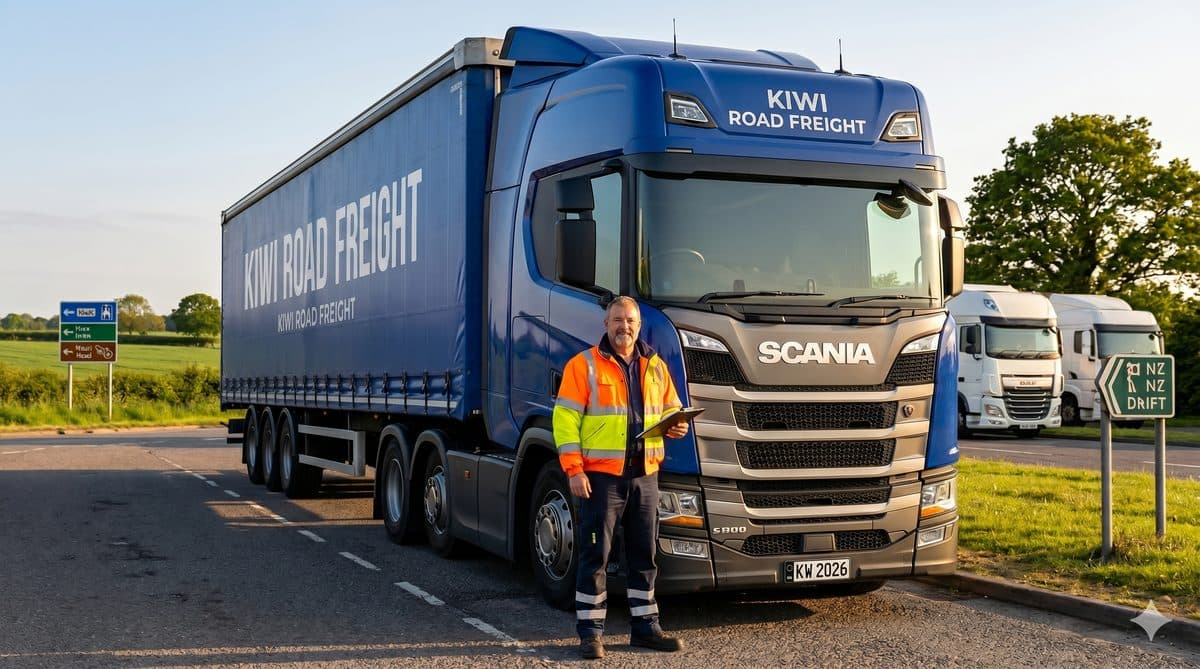
Owner-Operator Trucks Insurance
Tailored insurance packages for independent owner-operators running their own truck as a business, including income protection and vehicle cover.
⚠️ Key Risks
- •All business income depends on a single vehicle
- •No employment safety net if injured or unable to work
- •Downtime from breakdown or accident is immediate revenue loss
- •Contract obligations to principals if unable to deliver
- •Personal accident and income protection gaps
✓ Coverage Checklist
- ✓Comprehensive motor vehicle — agreed value
- ✓Carriers liability
- ✓Public liability
- ✓Downtime and loss of use
- ✓Personal accident and income protection
- ✓Breakdown cover
For an owner-operator trucker, the vehicle is not just an asset — it is the entire business. When the truck is off the road, the income stops. When the driver is injured, the business stops. The insurance requirements of an owner-operator are therefore both more acute and more personal than those of a fleet operator, and the package must address both the vehicle and the person behind the wheel.
There are thousands of owner-operators in the road transport sector across this country — running sub-contracts for larger carriers such as Mainfreight, Toll, or CourierPost, operating under principal transport companies as independent contractors on defined routes, or running their own customer relationships on local delivery circuits. The degree of business independence varies, but the core insurance requirements are consistent: a write-off or a serious injury cannot be allowed to end the business permanently. Insurance is what stands between a bad week and losing everything.
Agreed Value — The Most Important Decision an Owner-Operator Makes
For an owner-operator, getting the sum insured right is the single most important insurance decision you make. It is also the most commonly made mistake. Many owner-operators insure their truck at book value — the depreciated value shown in the fleet schedule or the accounting records — rather than at replacement cost. The difference between these two figures can be enormous in the current market.
If your truck is written off and you are settled on a market value assessment rather than a pre-agreed replacement value, you may receive significantly less than you need to replace your vehicle. Without a vehicle, you have no business — and the gap between what the insurer pays and what a replacement truck costs comes out of your own pocket.
In the current environment — where new Scania, Kenworth, MAN, and Volvo prime movers carry delivery lead times of 12 to 18 months, and secondhand truck prices have been elevated by supply chain constraints — agreed value policies are essential for every owner-operator. The agreed value is established at policy inception or renewal, documented in the schedule, and paid in full if the vehicle is a total loss. No argument, no depreciation, no market value assessment at the worst moment of your working life.
Ready to get specialist cover?
Connect with a specialist broker — response within 24 hours.
Your broker should review your agreed value at every renewal. Truck values are dynamic — what was correct two years ago may leave you materially underinsured today. A specialist broker who understands the current secondhand HGV market can advise on appropriate agreed values for your specific make, model, specification, age, and condition.
Single-Truck Dependency — Understanding Your Real Exposure
The fundamental financial risk of the owner-operator model is single-truck dependency. A fleet operator with ten trucks can survive one truck being off the road. An owner-operator cannot. The entire business revenue stream runs through the single vehicle — which means downtime from any cause (accident, breakdown, COF failure, theft, or weather damage) creates an immediate and complete loss of income.
This exposure is dramatically different from employment, where illness or injury triggers sick leave, ACC, or employer support mechanisms. As an independent contractor, you have none of these protections unless you specifically arrange them. The insurance programme for an owner-operator must be designed around this reality.
Downtime Cover — Keeping Cash Flowing
Downtime cover pays a daily or weekly benefit while your truck is off the road for repairs following a covered event. It does not cover breakdown (that is addressed by a separate breakdown assistance policy) — it covers the revenue gap while your truck is being repaired after an insured event (accident, theft, fire, storm).
For a typical long-haul artic on the SH1 corridor running general freight, the daily revenue on a normal working day is $1,500 to $2,500. A major accident requiring a full cab rebuild can take eight to fourteen weeks. At $2,000 per day, fourteen weeks of downtime represents $196,000 in lost revenue — a sum that would bankrupt most owner-operators without downtime cover.
Ready to get specialist cover?
Connect with a specialist broker — response within 24 hours.
The daily rate you insure should be realistic and based on your actual average daily earnings. Insurers will request financial statements to verify earnings at claim time. Insuring above your actual daily earnings is insurance fraud; insuring below creates a coverage gap. Be accurate in your estimate and review the figure at every renewal as your income changes.
Personal Accident and Income Protection — The Human Risk
Downtime cover addresses vehicle off-road time — mechanical downtime, repair time after an accident. It does not respond when the driver is injured and cannot work. These are two completely different exposures, and both must be covered.
If you are the driver-owner and you are seriously injured in a road accident or a non-road incident (a loading yard accident, a fall on a slippery dock), ACC covers injuries that occur at work — but the ACC weekly compensation is capped at approximately $2,400 per week for the 2025-2026 year, adjusted for 80% of your pre-injury earnings up to that cap. If your actual weekly earnings exceed the ACC cap — which is common for experienced owner-operators running profitable long-haul operations — the gap between your actual income and the ACC compensation is uninsured without a personal accident top-up policy.
Personal accident cover pays a weekly benefit during your recovery period, on top of ACC, up to the insured amount. It also pays a lump sum if you are permanently disabled and cannot return to work as a truck driver. This lump sum is critical: it funds the transition out of the industry (retraining, business purchase, or retirement), covers any debts or financial obligations, and provides a buffer while your long-term situation is resolved.
There is also a gap in ACC that many owner-operators do not appreciate until it is too late. ACC covers occupational injuries — incidents that occur at work, in the vehicle, or in the course of employment. But non-occupational medical events (heart attack, stroke, cancer, non-work accident) are not covered by ACC at all. If you suffer a medical event that prevents you from driving for six months, ACC provides nothing. Income protection insurance — which pays a monthly benefit for any inability to work, regardless of cause — closes this gap completely.
Ready to get specialist cover?
Connect with a specialist broker — response within 24 hours.
Carriers Liability and Personal Exposure Under the CCLA
Under the Contract and Commercial Law Act 2017 (CCLA), carriers have a legal duty of care for goods in their custody. If you are an owner-operator carrying third-party freight and that freight is lost or damaged in your care — whether through an accident, theft, or any other covered event — the goods owner can and will pursue you personally for the value of the loss.
Unlike a large fleet operator with corporate structure, legal resources, and financial depth, an owner-operator facing a major carriers liability claim without insurance is personally exposed. Your home, your savings, and your personal assets can be at risk. Carriers liability cover — with a limit sized to the maximum value of freight you carry on any single run — is non-negotiable.
Work through your typical freight values with your broker: What is the most valuable single consignment you carry? What is the most your clients' contracts require you to be insured for? What does your principal carrier's sub-contractor agreement specify? These answers determine the minimum carriers liability limit your policy must carry.
Working for a Principal — Contractor Insurance Obligations
Many owner-operators work under contract to a principal carrier or freight company. These contracts typically specify minimum insurance requirements as a condition of the transport contract — and failure to maintain that insurance can result in contract termination and loss of your primary income source.
Common requirements include: - Minimum public liability limits (often $1,000,000 to $2,000,000) - Minimum carriers liability limits per consignment - Comprehensive motor vehicle cover on agreed or market value basis - Evidence of cover (certificate of currency) at contract start and annually
Ready to get specialist cover?
Connect with a specialist broker — response within 24 hours.
Your broker should review your principal contract and confirm that your policy meets all contractual requirements. A policy that is standard for the general market but falls short of a specific contract requirement puts your contract — and your income — at risk.
ACC and the Superannuation Gap
A point that is frequently overlooked in owner-operator financial planning: ACC's weekly compensation is a temporary benefit. For long-term or permanent disability, ACC provides a permanent impairment lump sum and ongoing weekly compensation — but the ongoing benefit is not indexed to your pre-injury income level in the way that a good income protection policy is.
Owner-operators also have no employer-paid KiwiSaver contributions. As a self-employed person, your retirement savings are entirely your own responsibility. A serious injury that prevents you from working during your prime earning years not only reduces your current income but potentially devastates your retirement savings accumulation. A comprehensive personal accident and income protection package — discussed with a financial adviser alongside your business insurance programme — addresses both risks before they become crises.
COF Compliance and the Revenue Gap
One of the specific downtime risks for owner-operators that many operators underestimate is COF (Certificate of Fitness) failure. If your truck fails a COF inspection — brake defect, steering issue, lighting failure, tyre condition — it cannot operate until repaired and re-inspected. COF failure can ground a vehicle for two days or two weeks depending on the nature of the defect and the availability of parts and workshop time.
Standard downtime cover pays a benefit when the vehicle is off the road following an insured event (accident, theft, fire). COF failure due to mechanical defect is typically not an insured event under a motor vehicle policy — it is a maintenance and compliance issue. Preventive maintenance programmes that catch defects before they cause COF failure are the best risk management approach. A documented pre-trip inspection regime and regular workshop servicing reduce both the frequency of COF failures and the scrutiny you receive from [Waka Kotahi NZTA](https://transport.govt.nz) compliance officers on the road.
Ready to get specialist cover?
Connect with a specialist broker — response within 24 hours.
The NRC and Transporting NZ Owner-Operator Resources
Both the [National Road Carriers Association](https://natroad.co.nz) and [Transporting NZ](https://transportingnz.org.nz) offer resources specifically relevant to owner-operators: preferred insurance programme access, template driver contracts for sub-contractor arrangements, industry pay rate guidance, and regulatory update services. For an owner-operator without the back-office support that large fleet operators have, these resources provide genuine value.
NRC's preferred insurance programme — accessed through specialist brokers with established NRC relationships — is designed to suit the specific needs of single-operator and small-fleet HGV businesses. The programme includes coverage extensions relevant to owner-operators, from agreed value through to personal accident, in a package structure that avoids the gaps that can arise from assembling covers from multiple standard market products.
Building Toward a Fleet — Planning for Growth
Many owner-operators eventually move toward a small fleet — adding a second truck, a third, and growing the business beyond the single-vehicle model. Insurance planning for this transition is important: moving from an individual policy to a fleet policy changes both the pricing structure (burning cost rather than individual rate) and the administration model (single policy, single renewal date).
Your broker should be involved in the growth planning conversation before you add the second or third vehicle. Understanding how your claims history will affect your burning cost when you move to fleet rating — and what fleet structures are available at different fleet sizes — helps you make informed decisions about the pace of growth and the insurance budget required.
The transition from owner-operator to small fleet operator is one of the most financially exposed moments in a transport business's life. You are carrying the capital cost of additional vehicles, potentially employing drivers for the first time, and managing a larger and more complex insurance exposure — all simultaneously. Get the insurance structure right before the trucks arrive, not after.
Ready to get specialist cover?
Connect with a specialist broker — response within 24 hours.
To connect with a specialist broker for owner-operator truck insurance, complete the quote request on this page and expect a response within 24 hours.
Frequently Asked Questions
As an owner-operator, does my principal carrier's insurance cover me?
No. Principal carriers maintain their own insurance for their own vehicles and operations. As an independent contractor, you are responsible for your own vehicle insurance, public liability, and carriers liability. Never assume you are covered by a client's policy.
What income protection do I have if I'm injured and can't drive?
ACC covers work injuries — but the weekly compensation is capped. Personal accident cover pays a weekly income benefit on top of ACC during your recovery. If you're an owner-operator, this is not optional — it's the difference between recovering at home and losing your business.
Can I get a combined package that covers everything in one policy?
Yes — specialist HGV brokers can package vehicle, carriers liability, public liability, downtime, and personal accident covers into a single owner-operator package. This simplifies administration and ensures all covers are aligned with consistent definitions and limits.
Why is agreed value so important for an owner-operator compared to a fleet operator?
A fleet operator can survive one truck being written off at market value — there are other trucks earning revenue. An owner-operator cannot. If you're settled on depreciated market value and it's not enough to replace your truck, you have no business. Agreed value eliminates this risk entirely.
Get a Owner-Operators Quote
Specialist broker response within 24 hours