Logging truck insurance is one of the most specialist lines in the commercial vehicle market. The combination of extreme vehicle values, remote operations, high-risk roads, and catastrophic third-party liability potential means this is a risk that generalist insurers typically decline outright — and why specialist broker expertise matters enormously.
The logging industry is a cornerstone of this country's primary sector. Forestry and wood products generate around $6 billion in export revenue annually. The trucks that move logs from forest to processing plant or port are the backbone of that supply chain — and they face a risk profile unlike anything else on the road.
Why logging is different from general freight
Almost every risk factor in logging insurance is elevated compared to general freight operations.
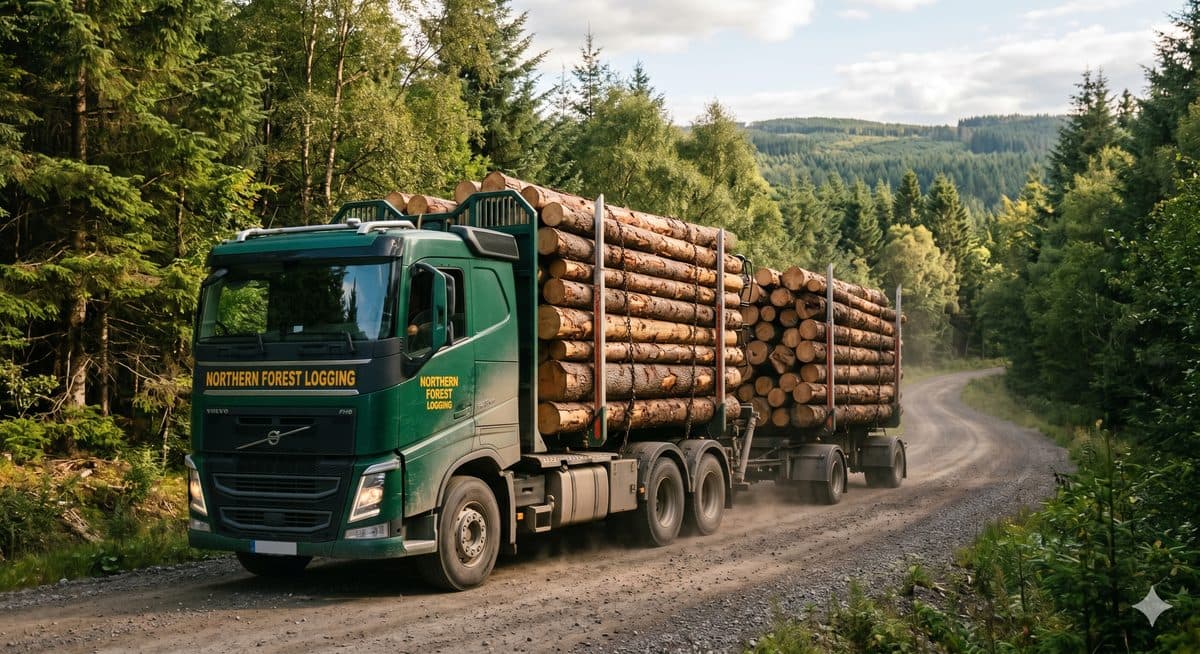
Vehicle values. A modern logging truck — a Scania R730 or Kenworth T659 with a purpose-built logging body, log bunks, and bolsters — represents $280,000–$450,000 in total asset value. The logging body and ancillary equipment alone can add $60,000–$120,000 to the base vehicle value. Jinker configurations, where the rear trailer unit is separate from the load, add further complexity to valuation.
Road conditions. Unsealed forestry access roads — narrow, steep, cut into hillsides with no barriers, subject to washout in heavy rain — create incident risk that simply does not exist on a sealed State Highway. Gisborne, Northland, Nelson, and Southland forestry operations run on roads that would be closed to public vehicles. A rollover on a steep East Coast forest road can put a $400,000 truck down a bank in seconds, with no barriers, no passing bays, and no mobile phone coverage.
Recovery costs. Recovering a rolled logging truck from a remote hillside requires specialist crane and recovery equipment, often on its own off-road vehicle. Recovery contractors must mobilise from the nearest town — which may be 60–90 minutes away. Recovery costs of $60,000–$150,000 are not unusual for serious bush road incidents; on extreme terrain in the Gisborne region, they can exceed $200,000.
Ready to get specialist cover?
Connect with a specialist broker. Response within 24 hours.
Third-party liability. A logging truck carrying 25–30 tonnes of logs on a public road is a severe hazard if anything goes wrong. Log spillages on State Highways have caused fatalities in this country. The civil and potential criminal liability following a serious log spillage is enormous — and the road clearing costs from NZTA for a log spillage incident on a busy State Highway can run to $150,000–$400,000.
Jinker configurations and insurance implications
The jinker — the rear steerable trailer unit used with logging trucks in New Zealand — creates specific insurance questions. Many logging combinations use a separate jinker that can be left at the forest access point while the prime mover and front trailer return for loading. This means the jinker may be parked on a forest road, on the shoulder of a State Highway, or on a logging landing at various times throughout the working day.
Insurers need to know the full configuration of your logging combination: prime mover, front trailer, jinker, bolsters, log bunks, and any self-loading equipment. Each component should be specifically declared and valued. A jinker can represent $40,000–$80,000 of asset value on its own.
If your combination separates operationally — the jinker left on-site while the prime mover hauls to the mill — confirm with your broker that both components are covered separately during separation periods. Some policies require both components to be connected during operation for the full agreed value to apply.
Forestry road regulations and compliance
Waka Kotahi NZTA regulates public road access for logging trucks, including mass limits, route approvals for overdimension loads, and RUC obligations. But the bush roads themselves — private forestry access roads — are governed by the forest owner's own rules and any relevant local authority consent conditions.
MPI has an interest in forestry operations through its role in wood product biosecurity and timber certification. WorkSafe NZ regulates the forestry sector under the Health and Safety at Work Act 2015, with specific guidance for logging and forestry work that is among the most detailed in any industry sector. Compliance with WorkSafe NZ guidance is both a legal obligation and an insurance underwriting consideration — insurers ask about your WorkSafe compliance record during underwriting.
Ready to get specialist cover?
Connect with a specialist broker. Response within 24 hours.
The covers that matter for logging
Motor vehicle — agreed value only. Never insure a logging truck on market value. With vehicles worth $280,000–$450,000 and replacement lead times of 12–18 months for European makes, agreed value at current replacement cost is essential. Set the agreed value with a dealer quote for a comparable replacement unit, including the full logging body and equipment.
Public liability — $5 million minimum. Given the catastrophic liability potential of a log spillage, the minimum recommended public liability limit for logging operations is $5 million. Many experienced operators carry $10 million. The additional premium for going from $5M to $10M is modest relative to the protection — and increasingly, timber companies and forest owners require $10M PL as a contract condition.
Road clearing and reinstatement — $100,000 minimum. Bush road reinstatement following a rollover can cost $80,000–$200,000, and forest owners and local roading authorities will bill the carrier for reinstatement of private and public roads damaged in an incident. Road clearing cover must address both public road and forestry road reinstatement costs.
Off-road recovery — $100,000 minimum. Standard recovery cost provisions in motor vehicle policies are often capped at $10,000–$25,000 — completely inadequate for a remote bush road incident. Make sure your policy specifically covers off-road recovery at a meaningful limit. For East Coast and Northland operators on steep terrain, $150,000 is not excessive.
Carriers liability. Log loads are owned by the forest owner or timber company, not you. If logs are lost or damaged in an incident, carriers liability responds to the forest owner's claim for the timber value.
Personal accident. Logging driving is physically demanding and incident-exposed. Driver personal accident cover — with a lump sum benefit for death or permanent disability, and a weekly income benefit during recovery — is essential for logging operators, particularly owner-operators without other income sources.
Ready to get specialist cover?
Connect with a specialist broker. Response within 24 hours.
The underwriting process
Logging insurance underwriting is thorough. Insurers will ask about years of experience in logging operations, vehicle specifications and GCM, the roads operated (sealed SH vs unsealed forestry roads vs private forest tracks), annual mileage breakdown between road types, driver experience levels, load securing equipment and certification, and claims history for the past five years.
Industry association membership — particularly the NZ Heavy Haulage Association and Transporting NZ — is an underwriting positive. These associations provide access to training resources, compliance support, and industry standards that reduce risk.
The NZHHA programme and Lloyd's access
The NZ Heavy Haulage Association (NZHHA) represents specialist heavy vehicle operators including logging carriers. The insurance arrangement for NZHHA members runs through Rothbury — a specialist commercial vehicle broker with 40+ insurer relationships and specific expertise in the logging sector.
Rothbury states it is a Lloyd's coverholder. Note the scope: the covers it lists under that are material damage, business interruption, natural disaster and cyber, not motor. For high-risk specialist operations — remote East Coast logging on steep terrain with a poor industry claims record — mainstream NZ insurers will decline or price punitively. Lloyd's capacity is often the difference between getting appropriate cover and being forced into an inadequate policy through a non-specialist channel.
What to watch out for
Incomplete declared value. Logging body, bolsters, bunks, jinker, and ancillary equipment must all be specifically valued and included. An insurer who lumps everything into a single depreciated vehicle value may not honour the full replacement cost of specialist components.
Public roads only policies. If your policy restricts cover to public roads and your routes include private forestry access roads, you may be uninsured on the roads where incidents are most likely.
Ready to get specialist cover?
Connect with a specialist broker. Response within 24 hours.
Inadequate road clearing limits. A $25,000 road clearing limit will not cover the reality of a serious forestry road incident. Push for $100,000+ and confirm it includes forestry road reinstatement, not just public road clearing.
If you are in the logging sector and your current insurance programme was not arranged by a specialist, request a review from a broker with specific logging expertise. The coverage gaps in generic HGV programmes are substantial — and in logging, the consequences of those gaps are severe.
General information for heavy vehicle operators, drawn from the primary sources linked in the article. It is not personal advice. Information about providers was accurate at the time of publishing and may change.